
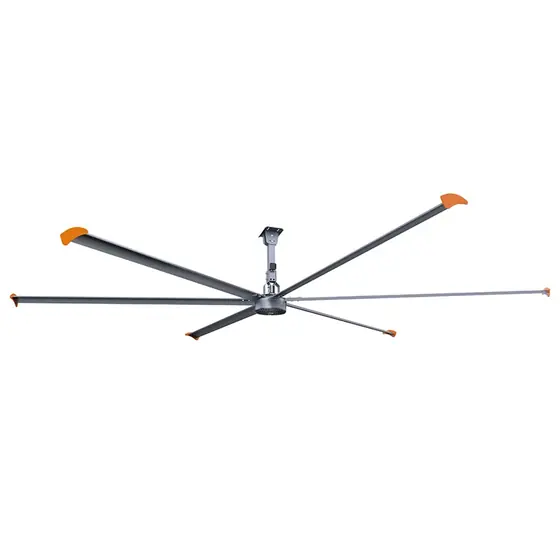
 HVLS Ceiling Fan
Industrial Ceiling Fan
A direct-drive IE5 fan that covers up to 1,700 m2 of high-bay floor on 1.5 kW, with no gearbox and no oil change for the life of the installation.
Products
HVLS Ceiling FanHVLS Floor FanWall FanHigh Temperature Axial FanDiesel GeneratorAll ProductsIndustries
Warehouse and LogisticsManufacturing WorkshopsCommercial and Public SpacesAgriculture and Livestock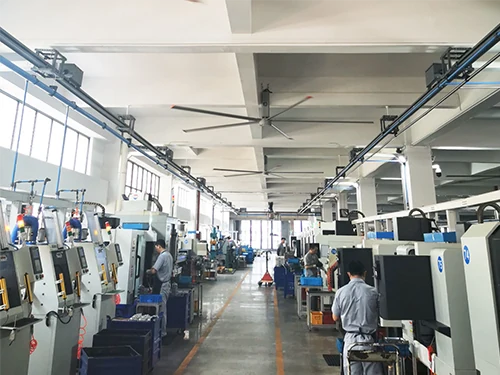
Every workshop cooling method works somewhere. The useful question is where each one fails, and in a large open workshop the failures are predictable.
If the workshop temperature is too high, people working in it are prone to heat stroke when it stays above the normal range for a long time, and work efficiency falls. In a high-temperature environment sweat secretion increases, the body loses too much water and dehydration becomes a real risk. Concentration becomes difficult, which brings drowsiness, mistakes and unnecessary losses, and in serious cases production accidents and casualties.
Mechanical equipment has the same problem in a different form. Machinery always generates heat during production. If that heat is not discharged or absorbed in time, it accumulates during operation, causing wear and reducing equipment life. At the extreme, excessive temperature can cause spontaneous combustion of equipment.
Fast cooling and a good cooling effect, which is why it is one of the most common choices for large companies and why dust-free workshops generally use it. The system combines a cold and heat source with an air conditioning system, using liquid vaporisation refrigeration to offset the indoor cooling load.
The limitation is scale. For large-area open workshops the investment and maintenance costs are relatively large, which is what rules it out in a press shop or a fabrication hall.
An evaporative air cooler combines a fan with a water curtain. A pump pours water over the curtain and, under positive pressure from the fan, air passes through it and is cooled. It sits between a fan and an air conditioner.
When large-scale cooling is required it does not suit. The number of units needed is very large, a single unit is very loud, and water consumption is very high. A large factory can consume dozens of tonnes of water a month on cooling fans.
The process happens on wet curtain paper. A thin water film on corrugated fibre paper absorbs heat from dry hot air drawn through it, and the cooled humid air mixes with room air and is discharged by the fan.
Installation location is limited, so it cannot cover the whole area of a large factory building, which makes the cooling effect insignificant at scale. The bigger drawback is humidity: a large amount of water is sprayed and volatilised, raising workshop humidity. Furniture coating, food processing and dry storage warehouses cannot work in high humidity, which greatly reduces the scope of application.
A negative pressure fan uses air convection and negative pressure ventilation, naturally drawing fresh air from the opposite side of the installation through a door or window and forcing hot indoor gas out quickly. Any problem with poor ventilation can be avoided.
Its biggest function is ventilation, smoke exhaust and dust removal, and on the cooling effect alone it is unsatisfactory. In a large workshop, ventilation and exhaust over a large area is slow and weak, the number of installations needed is very large, and overall power consumption is high.
The initial investment cost is suitable, local air volume is large and there are many models to choose from, which is why most enterprises still use them.
The disadvantages are many. Service life is short and units are often damaged. Floor-mounted horn fans affect the placement of the site and reduce production efficiency. A collision with a high-speed fan is a safety accident waiting to happen. The cooling effect is not obvious and coverage is very low, only tens of square metres, so a large workshop needs hundreds or thousands of units, with total power consumption and maintenance to match.
The large industrial fan is a ceiling fan with a diameter of up to 7.3 metres. The area covered is directly related to diameter, so it covers a wide area and is easy to clean. Compared with small fans and central air conditioning it offers low noise, small size and low energy consumption.
The air produced is like a natural breeze system, and 1 to 3 m/s is the air volume that gives the best cooling feeling on human skin. Employees can feel a temperature difference effect of 5 to 8 degrees without the airflow disrupting their work, which is what improves production efficiency in the hot months. It is widely used in tall industrial plants, logistics warehouses and similar buildings.
HVLS Ceiling Fan
A direct-drive IE5 fan that covers up to 1,700 m2 of high-bay floor on 1.5 kW, with no gearbox and no oil change for the life of the installation.
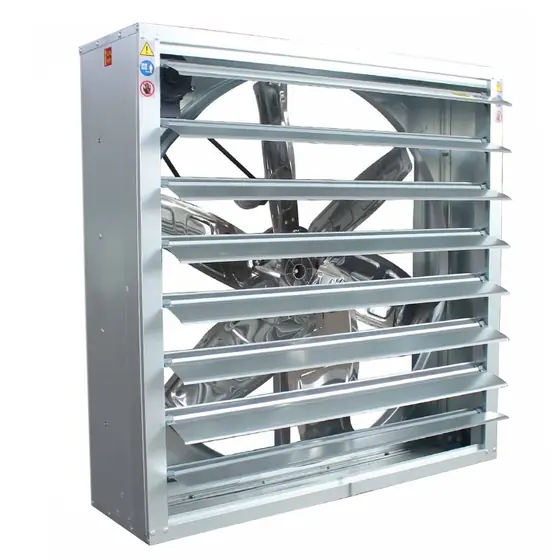 Wall Fan
One-piece formed housing with extra-thick zinc coating, automatic shutters and a bottom drain, for negative-pressure ventilation in hot, humid and smelly buildings.
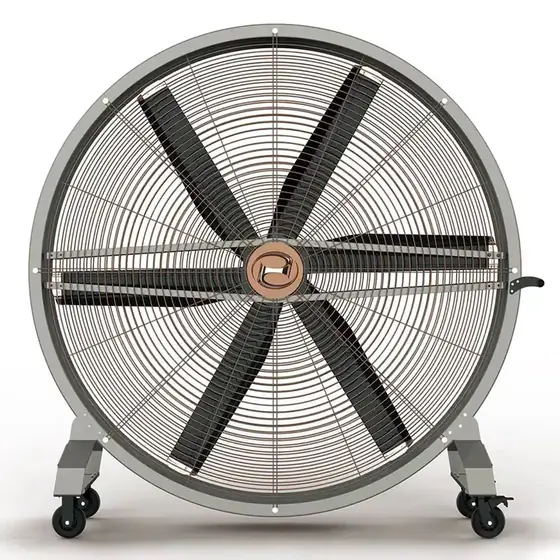 HVLS Floor Fan
A wheeled HVLS fan that throws air up to 28 m in open space, for bays where nothing can be hung from the roof and the cooling has to follow the work.
For general comfort across the floor, the large industrial ceiling fan, because coverage scales with diameter and energy consumption stays low. Where the process puts heat or fume into the building, add negative pressure exhaust so the hot air actually leaves.
Because each covers only tens of square metres, service life is short, floor-standing units obstruct material handling and a collision with a high-speed fan is a safety incident. At the scale of a large workshop the unit count, power consumption and maintenance all become unmanageable.
Where added humidity is acceptable and the area is modest. It is ruled out in furniture coating, food processing and dry storage because of the moisture it introduces, and at large scale the unit count, noise and water consumption become the problem.
That is usually the right answer. Exhaust ventilation removes the process heat and fume, and circulating fans make the remaining air feel cooler on the floor. Specifying only one of the two is the most common mistake we see.
The guides get you to a shortlist. Building dimensions and duty get you to a price.