
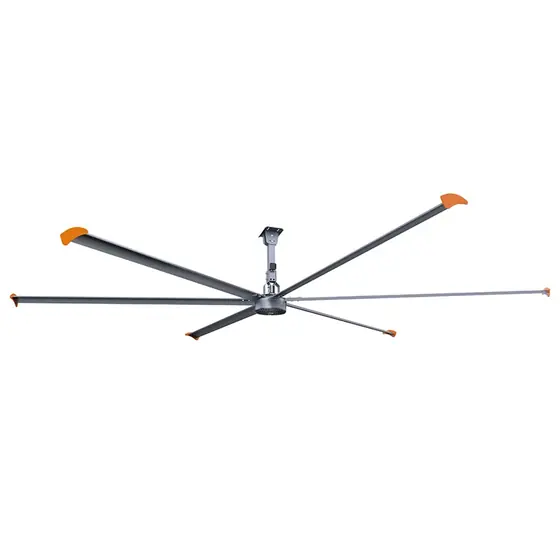
 HVLS Ceiling Fan
Industrial Ceiling Fan
A direct-drive IE5 fan that covers up to 1,700 m2 of high-bay floor on 1.5 kW, with no gearbox and no oil change for the life of the installation.
Products
HVLS Ceiling FanHVLS Floor FanWall FanHigh Temperature Axial FanDiesel GeneratorAll ProductsIndustries
Warehouse and LogisticsManufacturing WorkshopsCommercial and Public SpacesAgriculture and Livestock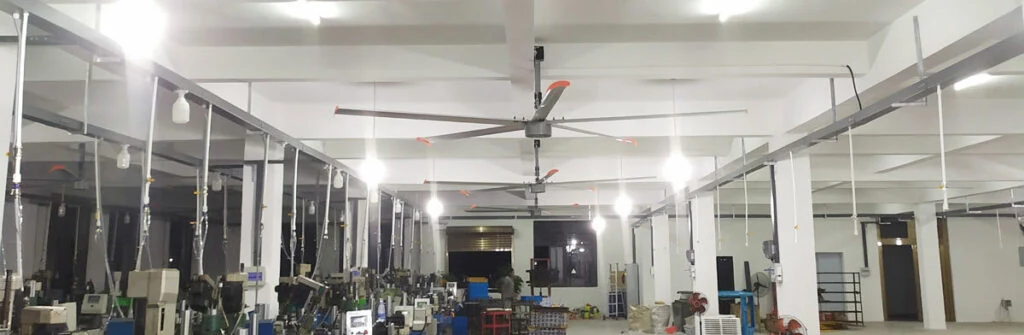
Three figures describe an industrial fan honestly: wind speed, air volume and rotating speed. Each one trades against the others, and quoting one alone is how buyers get misled.
Wind speed is one of the important performance indicators for identifying a large industrial fan, but it cannot be just the speed value at a certain position, because a single point does not fully reflect the performance of the fan.
Wind speed depends on the shape, area, height and speed of the fan blade. The influence of blade shape, area and height is more complicated than the influence of speed. The faster the fan turns, the faster the wind speed at a given point, which is exactly why a quoted wind speed with no context is close to meaningless.
Air volume is the volume of air passing through the cross section of the fan per unit of time, usually stated in cubic feet per minute or cubic metres per minute. It is the overall index used to measure fan performance, and unlike wind speed it is not limited by structure, size or method, so it can be applied to any air-guided equipment.
Air volume equals average wind speed multiplied by the wind passing area. That single relationship explains why a slow fan with a 7.3 m blade moves far more air than a fast fan with a 600 mm blade, and why the large slow format exists at all.
Speed is basically the way to determine the motor performance of a fan, and many other characteristics follow from it: wind speed, air volume, wind pressure, noise power and even service life.
The higher the speed, the stronger the performance, the greater the air volume and the greater the wind pressure. But high speed also means more friction, more vibration, greater noise and shorter life for the components at the core. As speed increases, power consumption increases with it.
That trade-off is the whole argument for high volume at low speed. Increasing blade area rather than rotating speed buys air volume without buying noise, vibration and wear.
Ask for air volume at a stated static pressure, not a headline wind speed at an unspecified point. Ask what rotating speed produces it. Then look at what the fan is built from, because the higher the speed, the more the bearing, the blade attachment and the balancing matter.
For drying and hazardous duties the same discipline applies. Send the air volume and static pressure you need rather than a fan diameter, and let the supplier select the diameter, the speed and the blade angle against it.
HVLS Ceiling Fan
A direct-drive IE5 fan that covers up to 1,700 m2 of high-bay floor on 1.5 kW, with no gearbox and no oil change for the life of the installation.
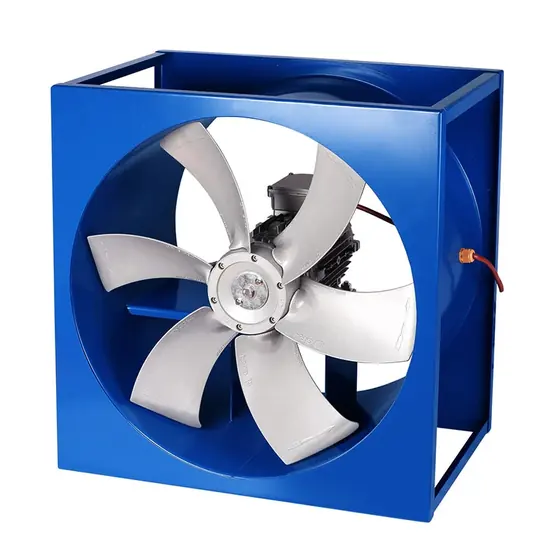 High Temperature Axial Fan
Rated for 130 C ambient and 98 percent humidity, in eleven diameters and four mounting types, for paint lines, tobacco, rubber, pharmaceutical and timber drying.
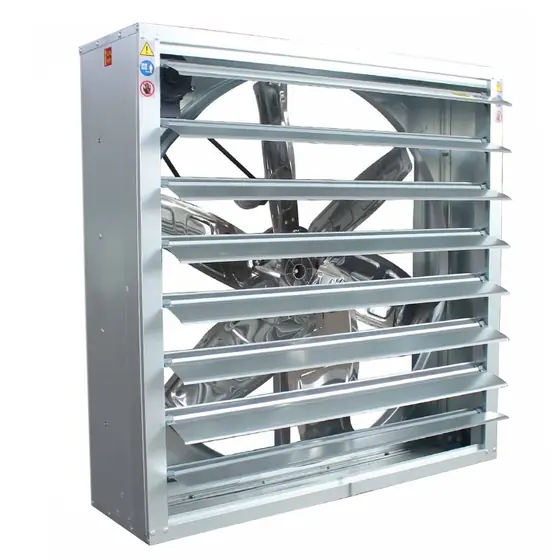 Wall Fan
One-piece formed housing with extra-thick zinc coating, automatic shutters and a bottom drain, for negative-pressure ventilation in hot, humid and smelly buildings.
No. Wind speed measured at one point tells you very little, and raising speed raises friction, vibration, noise and power consumption while shortening component life. Air volume at a stated pressure is the honest comparison.
Air volume and static pressure required, the ambient temperature and humidity, and the opening or mounting available. The fan size should be the supplier's answer, not your input.
Because air volume is average wind speed multiplied by the passing area. Enlarging the area is a cheaper way to buy air volume than raising speed, and it avoids the noise and wear that speed brings.
Three: 2900 r/min, 1450 r/min and 960 r/min, chosen so the circumferential velocity of the impeller stays within condition for the diameter.
The guides get you to a shortlist. Building dimensions and duty get you to a price.