
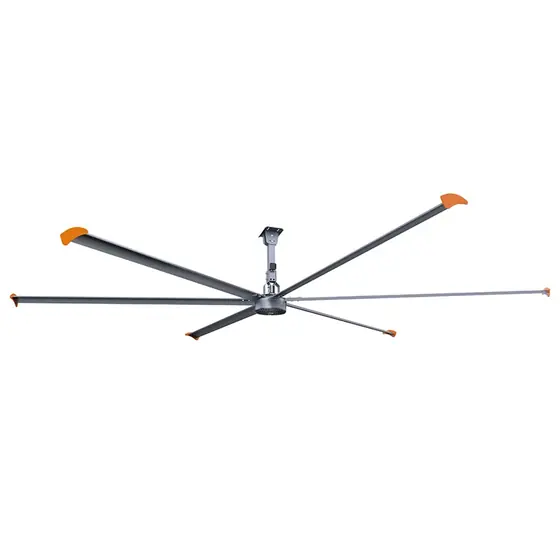
 HVLS Ceiling Fan
Industrial Ceiling Fan
A direct-drive IE5 fan that covers up to 1,700 m2 of high-bay floor on 1.5 kW, with no gearbox and no oil change for the life of the installation.
Products
HVLS Ceiling FanHVLS Floor FanWall FanHigh Temperature Axial FanDiesel GeneratorAll ProductsIndustries
Warehouse and LogisticsManufacturing WorkshopsCommercial and Public SpacesAgriculture and Livestock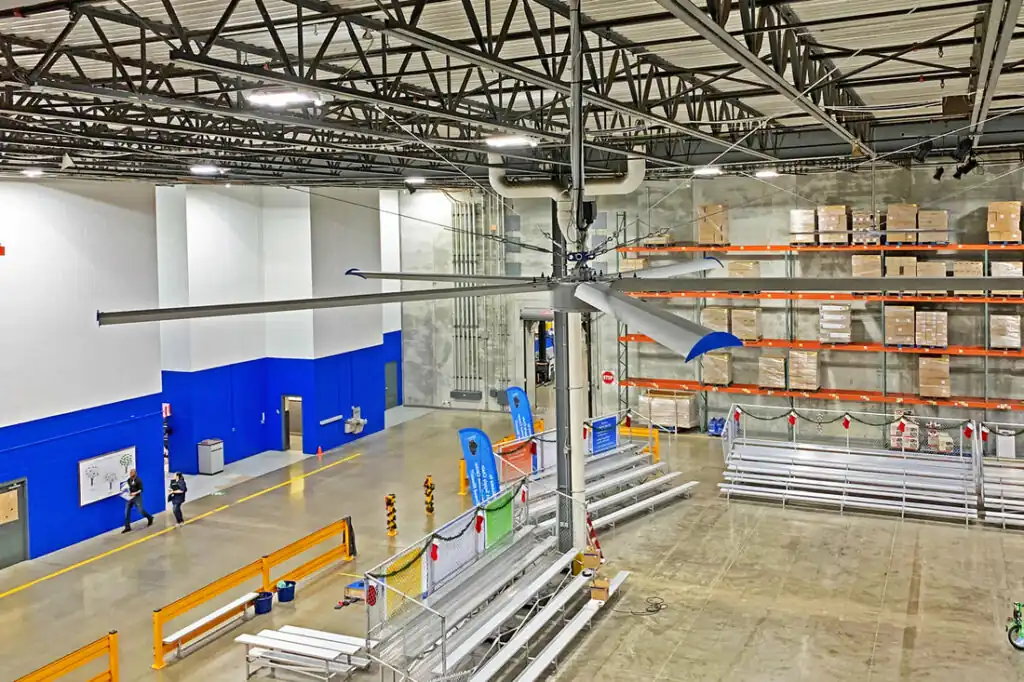
Destratification is the unglamorous half of what an HVLS fan does, and it is the half that pays in winter. Warm air rises and sits at the roof; the fan run slowly mixes it back down. In summer the same fan runs faster and the moving air column changes what people feel. One piece of equipment, two seasons, two mechanisms.
Nothing here is a slogan. Each stage is a thing somebody has to do, and most delays on a fan project come from skipping one of them.
We start from the building rather than the fan: length, width, clear height, roof structure, racking or crane layout, and the grid voltage. What the building is used for matters too, because a picking aisle and a welding bay want different air speeds at the floor.
Clear height decides the range. Up to about 7 m the commercial fan at 2.4 m to 3.7 m; above that the industrial fan at 3 m to 7.3 m, with motor power selected from 0.37 kW to 1.5 kW against diameter and duty.
Fan positions are marked on the building outline with estimated coverage per fan. Obstructions reduce coverage, so the layout is drawn rather than derived by dividing the floor area.
Motors are wound for the site supply, and the control point for the four-button controller is planned so the cable route is known before installation begins.
Fixing detail issued for cement beam, I-beam or square steel structure, with the loads at the fixing point, or a pole mount where there is no structure above.
Stator withstand-voltage testing and blade dynamic balancing on every unit, then a functional test with the controller fitted before crating.
Fans crated and consolidated with any exhaust fans and spares into one container to the destination port you name.
Installation is normally one to two working days per building with a scissor lift and two or three people, with the supply connection made by a licensed electrician. Remote support during commissioning, and spares supported from the same factory afterwards.
HVLS Ceiling Fan
A direct-drive IE5 fan that covers up to 1,700 m2 of high-bay floor on 1.5 kW, with no gearbox and no oil change for the life of the installation.
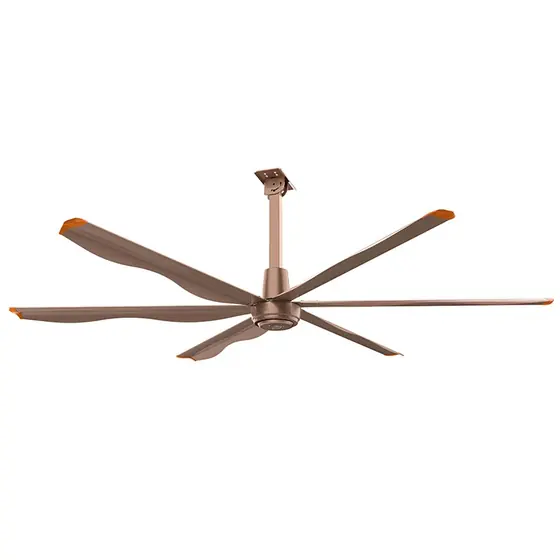 HVLS Ceiling Fan
For rooms under about 7 m where the fan is part of the interior: 330 m2 of coverage, under 38 dB, and a bronze airfoil blade that does not look like plant equipment.
From clear height, building geometry and the obstructions in the space, against the stated coverage figures of up to 1,700 m2 for the industrial range and around 330 m2 for the commercial range. Racking, cranes, mezzanines and partitions all reduce it, which is why we ask for the layout.
In a heated building with a high roof, that is where the biggest saving sits. Heat collects at the roof and is lost through it. Running the fans slowly through the cold months puts that air back into the occupied zone.
Building length, width and clear height, roof structure type, the layout of racking, cranes or partitions, and the grid voltage, phase and frequency. With those we can return a layout in one reply.
A local contractor, with the supply connection made by a licensed electrician. We supply the mounting detail, the wiring diagram and remote support during commissioning.
Yes, and buildings often start with one bay. The range is consistent enough that fans added years later sit alongside the originals on the same control approach.
Send what you already know about the building or the duty. We will tell you what is missing before you have to ask.