
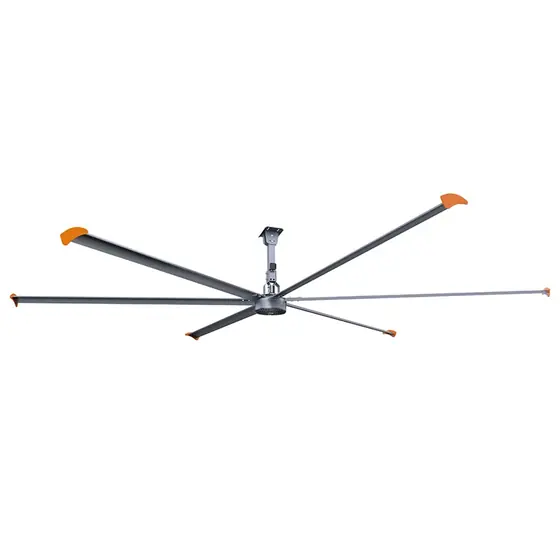
 HVLS Ceiling Fan
Industrial Ceiling Fan
A direct-drive IE5 fan that covers up to 1,700 m2 of high-bay floor on 1.5 kW, with no gearbox and no oil change for the life of the installation.
Products
HVLS Ceiling FanHVLS Floor FanWall FanHigh Temperature Axial FanDiesel GeneratorAll ProductsIndustries
Warehouse and LogisticsManufacturing WorkshopsCommercial and Public SpacesAgriculture and Livestock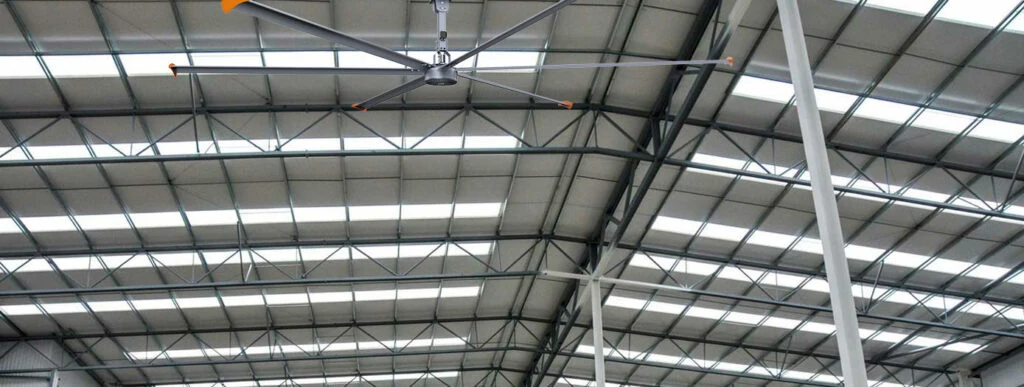
HVLS fans measure from roughly 2 m to 7.3 m across and move air by blade area rather than tip speed. This guide covers what they do, why high-ceilinged buildings need them and how the three types differ.
HVLS fans are large industrial fans, typically measuring 6 feet and up, built to circulate a large amount of air using air streams. Air is pulled from above the fan and pushed down in a conical shape to the floor below. Diameters across the range run from 2.4 m (8 ft) to 7.3 m (24 ft).
Aerodynamic design is the main feature, not size alone. Optimising the blade shape creates additional energy, and tilted blades provide more air volume. A large amount of airflow creates a cooling effect of 5 to 8 degrees lower, and the same airflow helps minimise humidity. Humidity and airflow are the two most critical factors in creating thermal comfort, which is why a fan that influences both does more than a fan that only moves air.
Compared with air conditioning and other conventional fans, an HVLS fan is the most effective way to cool a big room, and it is around 30 percent more efficient. One HVLS fan displaces multiple small fans. Against an air conditioner it needs less energy because it does not lower the air temperature at all; instead it maximises air diffusion to create a comfortable environment.
The arithmetic is worth doing. A 1 PK air conditioner covers a 4 by 4 metre area and needs 900 watts. One HVLS fan covers an area of 1,000 m2.
Beyond power, the fan improves air quality by increasing air movement and ventilation, letting airborne dust and other contaminants clear. Installation usually takes one to two working days with almost no requirement, and the fan can even be pole-mounted where there is no ceiling. Noise stays low because the fan does not need high power, and a quieter environment improves productivity and focus.
Traditional HVLS fans run very quietly with high air circulation, a dust-proof motor reducer and ultra-low energy consumption, with 20 percent wider blades to increase air volume.
PMSM HVLS fans are the most recent technology with a 91 percent efficiency rating. This is the type the current Diamond industrial and commercial ranges use.
Commercial HVLS fans are ideal for small to medium sectors where the room height is no more than about 7 m. They produce great airflow with less noise than other HVLS fans, are also used for industrial purposes, and are designed for longer durability.
Churches, mosques and other houses of worship, which usually have high ceilings and accommodate large numbers of people on important days, and which have historically struggled to provide comfortable airflow on a limited budget.
Warehouses, where the defining characteristic is a high ceiling and where the challenge is cooling the area and reducing humidity with less energy. Air conditioners and air coolers are not the answer because they may lower the temperature but not the humidity level, and humidity is the number one enemy in a warehouse because it damages products.
Beyond those, HVLS fans are used in industrial and factory spaces, livestock buildings, shopping malls, train and bus stations, workshops, distribution centres and gymnasiums.
HVLS Ceiling Fan
A direct-drive IE5 fan that covers up to 1,700 m2 of high-bay floor on 1.5 kW, with no gearbox and no oil change for the life of the installation.
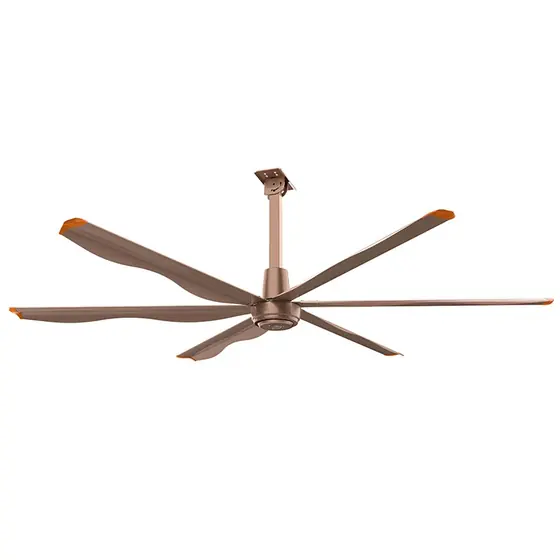 HVLS Ceiling Fan
For rooms under about 7 m where the fan is part of the interior: 330 m2 of coverage, under 38 dB, and a bronze airfoil blade that does not look like plant equipment.
Rooms with high ceilings of more than around 40,000 square feet are the classic case, but clear height matters more than area. Once a building is above about 5 m clear, air conditioning struggles to reach the floor and a fan starts to make sense.
No, and that is the point. It does not lower the air temperature; it maximises air diffusion so the space feels 5 to 8 degrees cooler. That is why it needs so much less energy than an air conditioner.
Installation is simple and normally takes one to two working days, but we strongly recommend a licensed electrician makes the supply connection.
The industrial ceiling fan and the commercial ceiling fan are both PMSM types. Use the commercial range up to about 7 m ceiling height and the industrial range above that.
The guides get you to a shortlist. Building dimensions and duty get you to a price.