
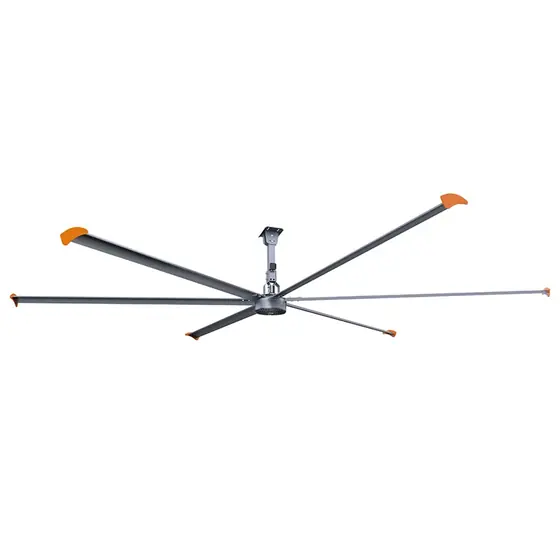
 HVLS Ceiling Fan
Industrial Ceiling Fan
A direct-drive IE5 fan that covers up to 1,700 m2 of high-bay floor on 1.5 kW, with no gearbox and no oil change for the life of the installation.
Products
HVLS Ceiling FanHVLS Floor FanWall FanHigh Temperature Axial FanDiesel GeneratorAll ProductsIndustries
Warehouse and LogisticsManufacturing WorkshopsCommercial and Public SpacesAgriculture and Livestock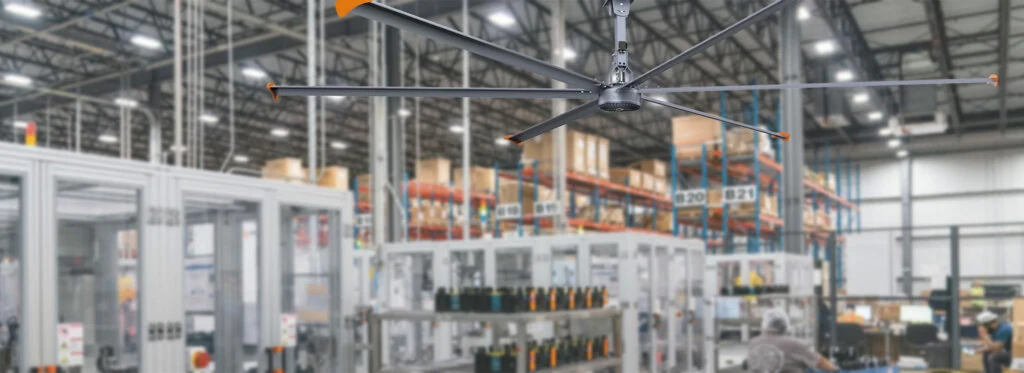
A large industrial ceiling fan solves ventilation and cooling for a 1,000 m2 workshop on about one kilowatt-hour. Asking what one costs, without context, gets an answer with no practical reference value.
A large industrial ceiling fan needs only about one kilowatt-hour of electricity to solve ventilation and cooling for a 1,000 square metre workshop. That is why more and more businesses accept and select them, and it is also why the next question is always what one costs.
It is worth being precise about the category. HVLS stands for high volume low speed. These are not household oscillating fans, wall fans or floor fans. The most common size for a large industrial fan today is 7.3 metres in diameter. Strictly speaking, a large industrial ceiling fan belongs to ventilation cooling equipment rather than to the fan category at all.
Different brands use different materials and different craftsmanship, so prices differ widely. On top of that, large industrial ceiling fans have moved through three generations, and there are substantial differences between them with a corresponding gap in price.
Most businesses now choose the third generation, because it uses a permanent magnet synchronous motor with no maintenance cost and lifetime maintenance-free operation. The third generation needs no periodic maintenance and no lubricating oil replacement, which also removes the risk of oil contamination on the floor below.
Service life is longer as well, because a third-generation fan can achieve IP64 waterproof and dustproof protection. Add high air volume, ultra-quiet running and large torque and the result is more economical, less labour-intensive and more comfortable to use. The first and second generations cannot do this because of their structure.
The HVLS fan was invented by an American company in 1999, and its purpose was to solve high summer temperatures for dairy cows on the farm. Because these fans produce a huge soft wind at low speed and low noise, similar to natural wind, they were gradually adopted in industrial plants and in tall commercial spaces such as railway stations, bus stations and gyms.
Around 2007 HVLS fans were introduced to the Chinese market. At first companies acted as agents for foreign brands, and local manufacturers developed from there. That is the same period in which this factory began focusing on production.
Go to the factory. An on-site inspection and comparison is how you understand the scale, the strength, the professionalism, the technical parameters and the manufacturing process of a manufacturer. Ask the manufacturer to provide a plan and a quotation after that inspection.
The price of one large industrial fan only becomes meaningful against a specific plan, because the plan determines the diameter, the count, the motor power and the mounting. Send the building dimensions, the clear height and the grid voltage and you will get a number you can actually compare.
HVLS Ceiling Fan
A direct-drive IE5 fan that covers up to 1,700 m2 of high-bay floor on 1.5 kW, with no gearbox and no oil change for the life of the installation.
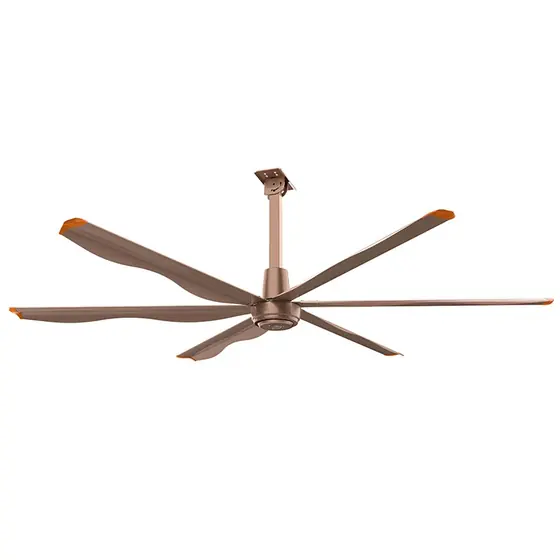 HVLS Ceiling Fan
For rooms under about 7 m where the fan is part of the interior: 330 m2 of coverage, under 38 dB, and a bronze airfoil blade that does not look like plant equipment.
Because a price without a plan has no practical reference value. Diameter, fan count, motor power and mounting all come from the building, and two quotations for the same building can differ legitimately by generation and materials.
One using a permanent magnet synchronous motor, with no maintenance cost, no lubricating oil to replace, no oil contamination risk and IP64-class waterproof and dustproof protection, giving longer service life along with high air volume, ultra-quiet running and large torque.
The published figure is that a large industrial ceiling fan needs about one kilowatt-hour to solve ventilation and cooling for a 1,000 square metre workshop. The Diamond industrial range uses motors from 0.37 kW to 1.5 kW depending on diameter.
If the order is significant, yes. It is the only reliable way to compare scale, equipment and process between suppliers, and we welcome visits with a week's notice so the line is running the products you want to see.
The guides get you to a shortlist. Building dimensions and duty get you to a price.