
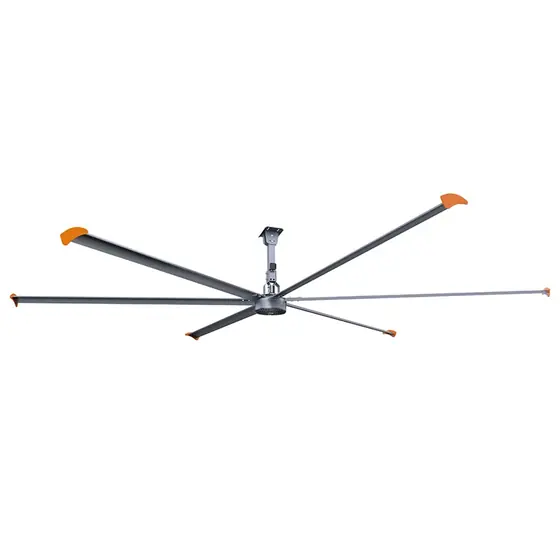
 HVLS Ceiling Fan
Industrial Ceiling Fan
A direct-drive IE5 fan that covers up to 1,700 m2 of high-bay floor on 1.5 kW, with no gearbox and no oil change for the life of the installation.
Products
HVLS Ceiling FanHVLS Floor FanWall FanHigh Temperature Axial FanDiesel GeneratorAll ProductsIndustries
Warehouse and LogisticsManufacturing WorkshopsCommercial and Public SpacesAgriculture and Livestock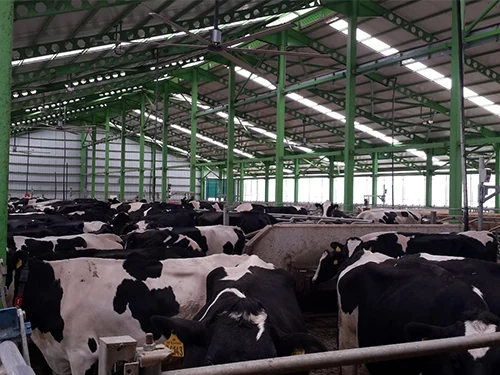
The large industrial HVLS fan was originally invented to ventilate and cool livestock. Working through the problems in a dairy, a duck house and a pig unit shows why the low-speed format is the one that works.
Dairy cows lose their appetite in hot summer weather. Add the nuisance of flies, mosquitoes, gadflies and insects and both reproductive capacity and milk production fall considerably. In rainy weather mosquitoes are infested, ventilation is poor, disease spreads and cow mortality increases.
In cattle trading markets, where farm cattle and beef cattle gather, the smell of dung lingers over the site, the air is cloudy and bacteria cross-infect. Both the cattle and the people are very uncomfortable.
Too cold and too hot both cause disease, and disease spreads rapidly through a herd. If prevention and treatment are not carried out in time it brings huge losses. Separately, a poorly ventilated cowshed lets a large volume of dung volatilise into toxic gas, damaging the health of both cattle and employees.
In hot summer conditions of high temperature and high humidity, bacteria breed and birds sicken quickly. During an outbreak the secretions and faeces of infected birds continue to discharge pathogens, contaminating the whole house, and birds that contact the pathogens again are rapidly reinfected.
Ducks are physically weak with limited resistance to the external environment. Once a duck is sick it spreads easily through faeces and mosquitoes, resulting in many infections and even death.
The complication is that the airflow cannot blow a duck directly, and certainly not onto the belly. That rules out high-speed direct blowing entirely. When a large HVLS fan runs, the slow rotation of huge blades generates a large volume of airflow that simulates a natural breeze of two to three levels and gently reaches the birds, bringing natural cooling with no danger of blowing them directly. The airflow circulates continuously inside the house and drives away mosquitoes along with the harmful gases produced by bacteria, mould and faeces.
The pig industry faces a considerable risk of disease control. Lack of air circulation, high temperature and mosquito transmission all cause herds to be infected with infectious diseases, which brings large losses.
To reduce that risk, improve summer growth rate and improve feed conversion, the temperature in the pig house needs to be controlled below 28 C after ventilation cooling, with the dirty air discharged. Fitting screens on windows to prevent mosquitoes reduces the probability of insect-borne disease and improves the sleep quality of the animals, which in turn reduces transmission of digestive, respiratory and infectious disease.
The industrial HVLS ceiling fan rotates slowly through large-diameter blades to form a three-dimensional circulating airflow covering the whole barn, similar to natural wind, which helps the animals dissipate heat. Appropriate temperature makes livestock comfortable, increases appetite, promotes digestion and speeds the growth cycle, reproduction and production capacity.
Low speed, high air volume, air circulation and three-dimensional air supply from top to bottom strengthen circulation in all directions and keep the environment clean and dry. The air volume generated drives airflow that exchanges quickly with fresh outdoor air through doors, windows or the roof, reducing bacteria in the air. Large industrial fans also drive away mosquitoes, which reduces disease risk and avoids large-scale infections at the root.
HVLS Ceiling Fan
A direct-drive IE5 fan that covers up to 1,700 m2 of high-bay floor on 1.5 kW, with no gearbox and no oil change for the life of the installation.
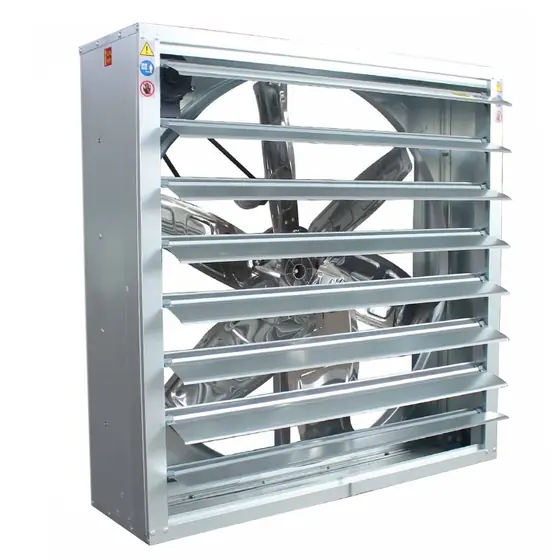 Wall Fan
One-piece formed housing with extra-thick zinc coating, automatic shutters and a bottom drain, for negative-pressure ventilation in hot, humid and smelly buildings.
No. The airflow is produced by the slow rotation of a very large blade set and simulates a natural breeze of two to three levels. That is exactly why the format suits ducks, which cannot be blown directly, let alone on the belly.
In an open-sided barn the ceiling fans usually carry the job, with the open sides providing exchange. In an enclosed poultry or pig house, wall exhaust fans running negative pressure are essential and the ceiling fans work alongside them.
The guidance we work to is holding the house below 28 C after ventilation cooling, while discharging the dirty air, with window screens to keep mosquitoes out.
Diamond HVLS fans are characterised by low energy consumption, low speed, low noise, large air volume and durability, and they have been used in farms, workshops, logistics and warehousing at home and abroad for many years.
The guides get you to a shortlist. Building dimensions and duty get you to a price.