
Embedded vs Extruded Fin Tube for Air Cooled Heat Exchangers
Both tubes are mechanically bonded, both suit air cooled heat exchangers, and they fail in different ways. Here is how the choice is actually made.
How the bond is made
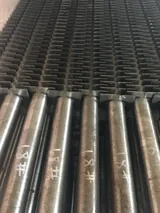
A G type tube has a helical groove machined into the base tube wall. The fin foot sits in the groove and the displaced parent metal is rolled back over it, so the fin is anchored rather than clamped.
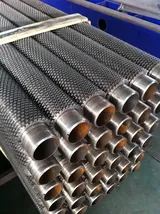
An extruded tube starts with an aluminium sleeve over the base tube. Rolling discs push metal out of the sleeve to form the fin, and the same operation shrinks what remains of the sleeve onto the tube.
What each protects
The extruded sleeve covers the base tube along the whole finned length, so the atmosphere never touches the parent metal. In coastal plants and chemical plant atmospheres, that is usually the deciding factor.
A G type tube leaves the base tube surface between fins exposed. It compensates with a bond that holds at higher metal temperature than a wound fin.
Size and geometry
G type covers base tubes from 16 mm to 80 mm with walls from 1.65 mm to 4.0 mm - the larger range.
Extruded covers 10 mm to 51 mm with walls from 1.65 mm to 3.0 mm, and opens fin pitch as wide as 15.0 mm against the 5.0 mm maximum of the G type process.
Both reach 16 mm fin height; extruded starts lower, at 5 mm, for compact bundles.
Choosing between them
Corrosive atmosphere outside the bundle: extruded.
Base tube larger than 51 mm: embedded, because extrusion does not reach that size.
Dusty air that needs a wide pitch: extruded.
High metal temperature with a clean atmosphere: embedded.
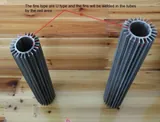
Tube Referenced Above
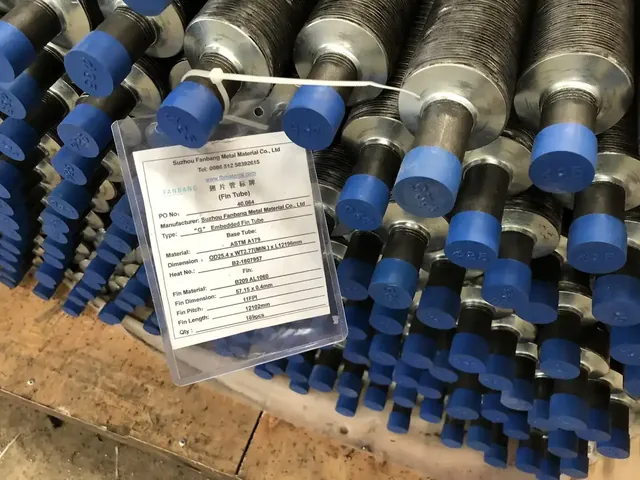 "G" Embedded Fin Tube
Fin strip rolled into a machined groove in the tube wall for permanent metal-to-metal contact
Base tube diameter: 16 mm - 80 mm · Base tube wall thickness: 1.65 mm - 4.0 mm
"G" Embedded Fin Tube
Fin strip rolled into a machined groove in the tube wall for permanent metal-to-metal contact
Base tube diameter: 16 mm - 80 mm · Base tube wall thickness: 1.65 mm - 4.0 mm
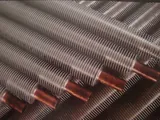
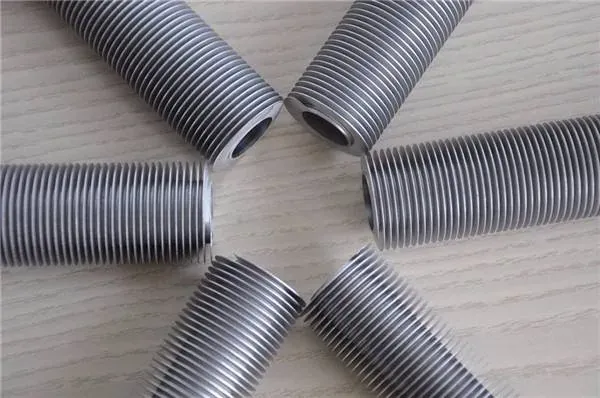 Extruded Fin Tube
Bimetal tube with the fin extruded from an outer sleeve, giving a seamless fin-to-tube wall
Base tube diameter: 10 mm - 51 mm · Base tube wall thickness: 1.65 mm - 3.0 mm
Extruded Fin Tube
Bimetal tube with the fin extruded from an outer sleeve, giving a seamless fin-to-tube wall
Base tube diameter: 10 mm - 51 mm · Base tube wall thickness: 1.65 mm - 3.0 mm
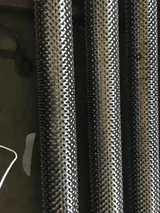
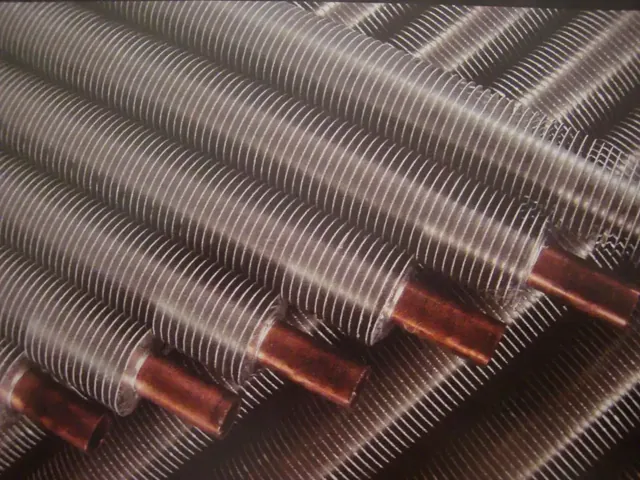 L/LL/KL Fin Tube
Tension-wound foot fin in three footprint styles, the standard choice for air cooled heat exchangers
Base tube diameter: 19 mm - 51 mm · Base tube wall thickness: 1.65 mm - 3.0 mm
L/LL/KL Fin Tube
Tension-wound foot fin in three footprint styles, the standard choice for air cooled heat exchangers
Base tube diameter: 19 mm - 51 mm · Base tube wall thickness: 1.65 mm - 3.0 mmMore guides
Reader Questions
Is an extruded fin tube always better?
No. It costs more, takes longer to produce and stops at 51 mm base tube diameter. It wins where the outside atmosphere would attack an exposed base tube.
Can both be supplied with a titanium base tube?
Yes. Base tube material for both processes includes stainless steel, carbon steel, alloy steel, titanium, nickel and copper.
Apply This to Your Bundle
Send the duty, the stream data and the envelope. We will tell you which geometry and grade the guide points to in your case.
[email protected] · Tel 0086 512 58392615 · Monday to Saturday, 08:30 - 17:30 China Standard Time (GMT+8)