






Stud Fin Tube
Individually welded studs for the dirtiest furnace and process heater duty
What Stud Fin Tube Is
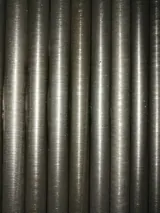
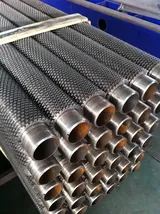
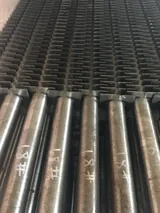
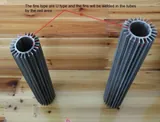
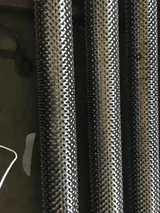
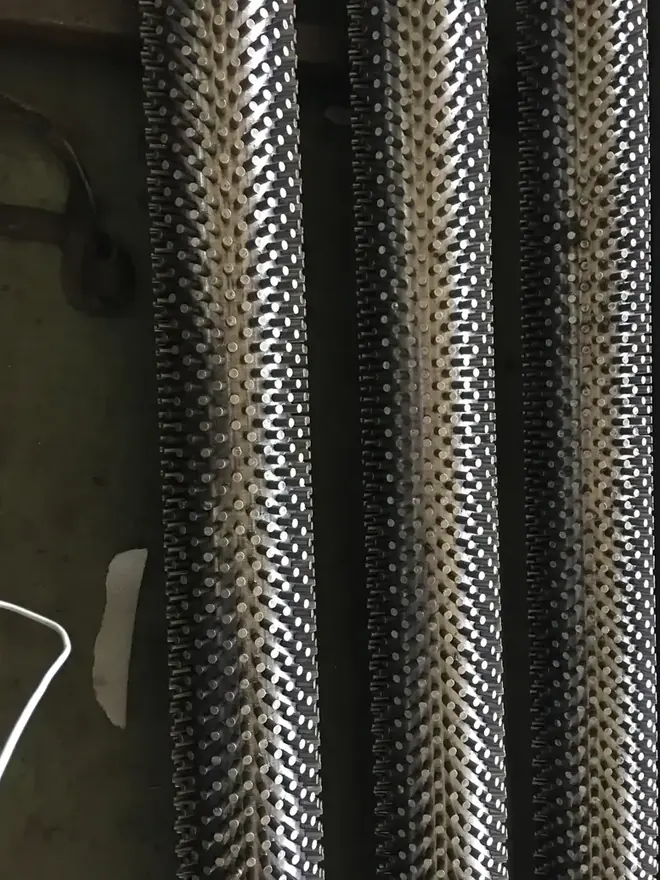
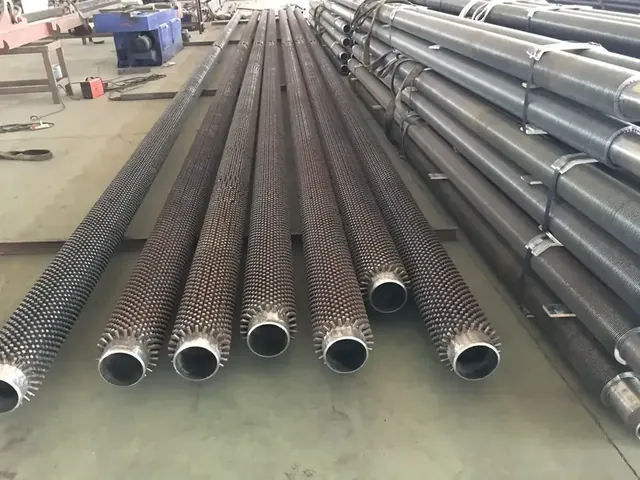
A stud fin tube carries rows of short cylindrical studs welded individually to the tube surface instead of a continuous fin.
Gas passes between the studs in every direction, so there is no continuous surface for slag or heavy ash to bridge across - the reason stud tubes survive in furnace radiant and shield sections.
Base tubes run from 38 mm to 273 mm with walls to 10.0 mm, which covers process heater tubes as well as smaller convection elements.
Why Engineers Specify It
Nothing for slag to bridge
Discrete studs leave gaps in every direction, so deposits fall away instead of blinding the bank.
Each stud individually welded
A damaged stud is a local repair, not a scrapped tube.
Heavy tube sizes covered
38 mm to 273 mm outside diameter with 3.5 mm to 10.0 mm wall suits furnace pressure parts.
Stud geometry tuned to the duty
Stud diameter 6.0 mm to 12.7 mm and height 10.0 mm to 30.0 mm set the added surface.
Where It Is Used
- Furnaces
- Chemical industry
- Petrochemical industry
- Power stations
Buyers Who Come to Us for This Tube
Fired heater and furnace builders
Radiant and shield sections with slagging fuels.
Refinery maintenance contractors
Replacement heater tubes on a turnaround schedule.
Power station boiler engineers
Zones where ash fouling defeats continuous fins.
What Goes Wrong Without It
Slag bridging across continuous fins
Discrete studs never form a continuous surface for deposits to span.
Fin damage meaning a whole tube is scrapped
Studs are welded one at a time, so local damage is locally repaired.
Large heater tubes needing extended surface
Stud welding works on tubes up to 273 mm where fin winding does not.
Stud Fin Tube Dimensions
These are the ranges our production lines run. Sizes outside them are quoted case by case rather than assumed.
| Item | Specification |
|---|---|
| Base tube diameter | 38 mm - 273 mm |
| Base tube wall thickness | 3.5 mm - 10.0 mm |
| Stud diameter | 6.0 mm - 12.7 mm |
| Stud pitch | 8.0 mm - 30.0 mm |
| Stud height | 10.0 mm - 30.0 mm |
Materials
| Component | Materials available |
|---|---|
| Base tube | Stainless steel, carbon steel, alloy steel, nickel |
| Studs | Carbon steel, stainless steel, alloy steel |
How It Is Made
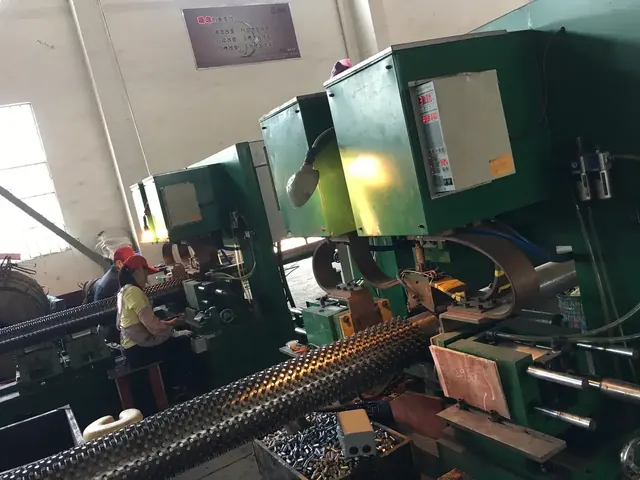
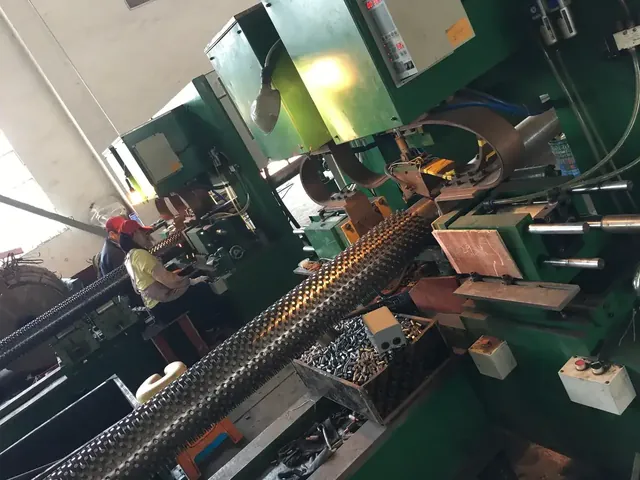
Stud Fin Tube on the Shop Floor
Inspection and Certification
Every tube passes eddy current and hydrostatic testing, with tensile, flattening, flaring, hardness and chemical analysis carried out on our own equipment. Fin pitch, fin height and finned length are verified as dimensional items in their own right.
The company holds ISO 9001:2015, CE certificate, Production licence for pressure pipe.
What Can Be Changed
- Base tube material and wall thickness within the range above
- Fin material, fin pitch and fin height to the bundle design
- Finned length and bare end length for the tubesheet joint
- Marking, packing and certificate scope for the destination market
Compared With the Alternatives
Stud tubes add the least surface per metre of any type on this site, and that is the point: they keep working where H type and spiral banks foul shut. Choose studs for slagging furnace duty, H type for ash-laden economizers, spiral for clean flue gas.
Use Guide
- Give fuel type and ash characteristics - slagging behaviour, not duty, is what selects a stud tube.
- Specify stud rows per circumference along with pitch; both are needed to calculate the added surface.
- For furnace tubes, confirm the base tube material certification requirement before production starts.
Stud Fin Tube FAQ
Why use studs instead of a continuous fin?
Because gas passes between the studs in every direction, slag and heavy ash cannot bridge across a continuous surface and blind the bank.
What stud sizes do you weld?
Stud diameter 6.0 mm to 12.7 mm, stud height 10.0 mm to 30.0 mm, stud pitch 8.0 mm to 30.0 mm.
What is the largest tube you can stud?
273 mm outside diameter with wall thickness up to 10.0 mm.
Can damaged studs be repaired in the field?
Studs are welded individually, so a local repair is possible without replacing the tube.
Often Compared With
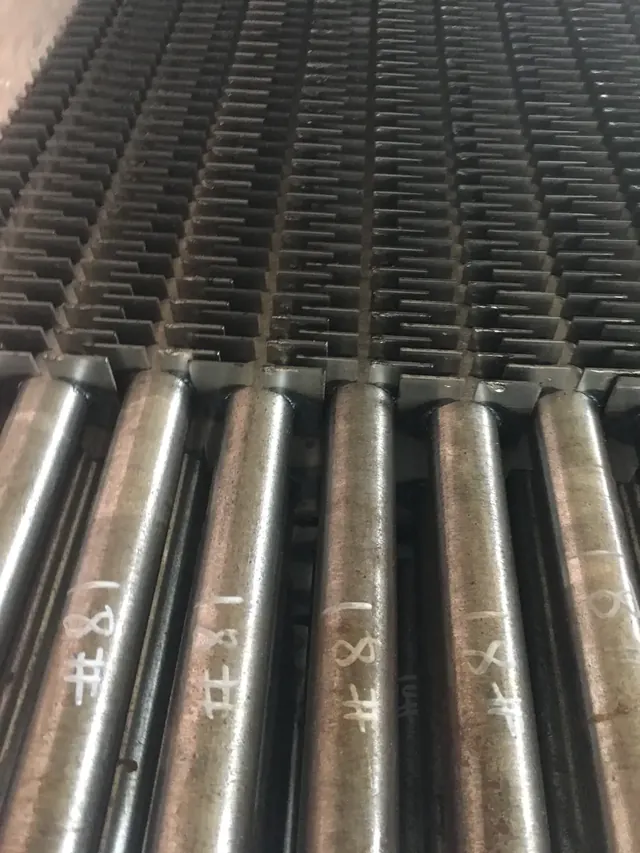 H/HH Fin Tube
Split square fins welded in pairs, leaving a straight ash lane along the tube
Base tube diameter: 25 mm - 73 mm · Base tube wall thickness: 3.0 mm - 6.0 mm
H/HH Fin Tube
Split square fins welded in pairs, leaving a straight ash lane along the tube
Base tube diameter: 25 mm - 73 mm · Base tube wall thickness: 3.0 mm - 6.0 mm
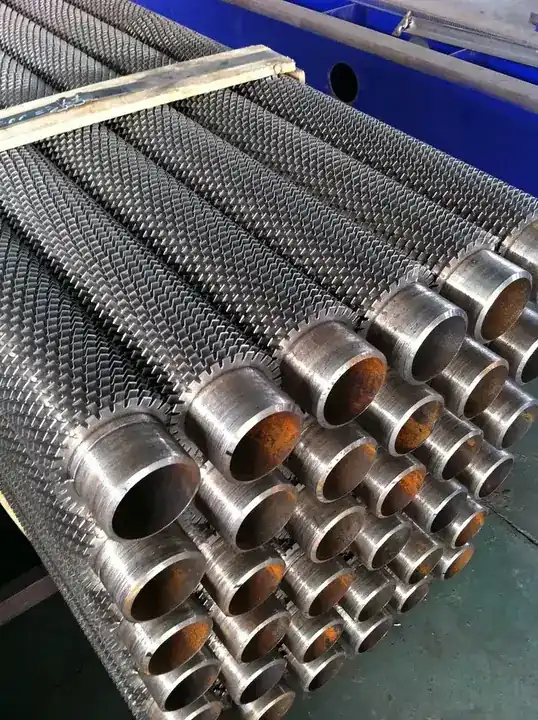 Spiral Fin Tube
Continuously welded helical fin for boiler, economizer and flue gas duty
Base tube diameter: 15 mm - 70 mm · Base tube wall thickness: 2.0 mm - 15.0 mm
Spiral Fin Tube
Continuously welded helical fin for boiler, economizer and flue gas duty
Base tube diameter: 15 mm - 70 mm · Base tube wall thickness: 2.0 mm - 15.0 mm
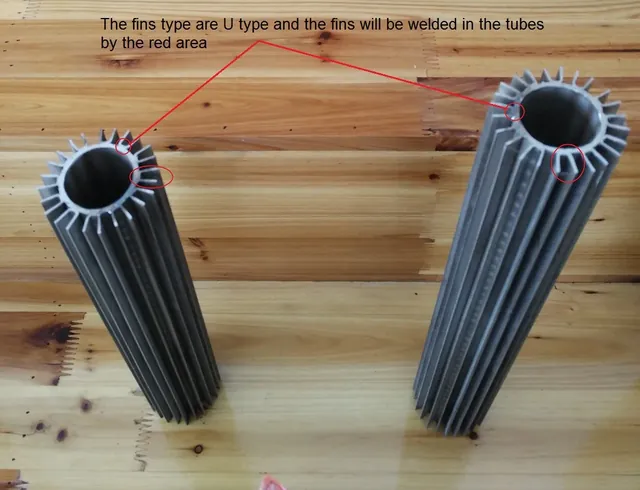 Longitudinal Fin Tube
Straight fins welded along the tube axis for viscous fluids and low velocity gas
Base tube diameter: 12 mm - 273 mm · Base tube wall thickness: 2.11 mm - 25.4 mm
Longitudinal Fin Tube
Straight fins welded along the tube axis for viscous fluids and low velocity gas
Base tube diameter: 12 mm - 273 mm · Base tube wall thickness: 2.11 mm - 25.4 mmIndustries using this tube
Related reading
Quote Stud Fin Tube From Your Drawing
Send base tube size, wall thickness, fin geometry, material and length. You get a quotation against the drawing, not a catalogue page.
[email protected] · Tel 0086 512 58392615 · Monday to Saturday, 08:30 - 17:30 China Standard Time (GMT+8)