
Design Guide
Temper Designations for Stainless Steel Strip
ANN, 1/4H, 1/2H, 3/4H, FH and EH are the tempers Yongxin supplies for ultra thin stainless steel strip. This guide explains what changes between them and how to pick one.
Published by Yongxin Precision Material (Wuxi) Co., Ltd. · Wuxi Jiangsu China
What Temper Actually Changes
Temper is the amount of cold work left in the strip after annealing and temper rolling. It does not change the alloy, so corrosion behaviour stays the same. What it changes is hardness, yield strength, how much the strip springs back after bending and how far it can be drawn before it cracks.
That is why temper is the more useful lever for a designer than grade. If a part cracks, going softer usually fixes it. If a part will not hold its shape, going harder usually fixes it. Neither change forces a requalification of the corrosion performance.
The Temper Ladder
- ANN fully annealed. Softest condition, highest elongation, deepest forming, most springback control. Used where the part is drawn or bent tightly.
- 1/4H quarter hard. A small amount of cold work. Still forms well but holds shape better than annealed strip.
- 1/2H half hard. The common middle ground for parts that are formed moderately and then need to stay put.
- 3/4H three quarter hard. Approaching spring behaviour, with limited forming capacity left.
- FH full hard. High strength and pronounced springback. Used for flat or lightly formed spring parts.
- EH extra hard. The hardest condition supplied, for parts where stiffness and edge retention matter more than formability.
Choosing a Temper for Your Part
- Identify the most severe forming operation the strip has to survive
- Identify what the part has to do after forming, hold a load, spring back, stay flat or cut
- Pick the softest temper that survives the forming step, because softer material is more forgiving in production
- If the finished part is then too soft, move up one step rather than jumping to full hard
- Prove it with a sample before committing a tool
If you would rather work in numbers than designations, state the yield strength, tensile strength, elongation and hardness you need and we will select the temper. Use the hardness conversion table if your requirement is written in a scale your gauge cannot measure.
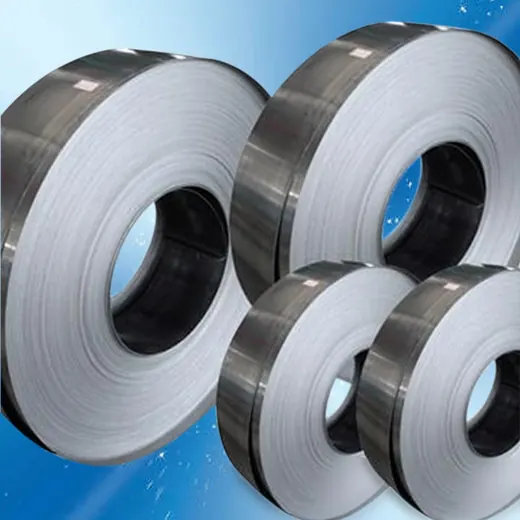 Ultra Thin Stainless Steel Foil/Coil0.05 - 1.0 mm thickness / 10 - 610 mm widthCold rolled SUS304, SUS301, 316L and SUS430 strip in soft and hard tempers for stamped springs, contacts, shields, medical parts and battery hardware.
How Temper Is Produced at the Wuxi Plant
Strip is annealed in a horizontal continuous annealing furnace or in bell type annealing furnaces, then temper rolled and passed through a stretch bending leveller imported from Burghardt and Schmidt in Germany. Hardness and tensile properties are verified in the plant laboratory before release.