
Ceramic Heat Accumulation Substrate
Honeycomb ceramic media for heat storage and heat exchange, widely applied in metallurgy, petroleum and chemical industry, electric power and boiler applications.
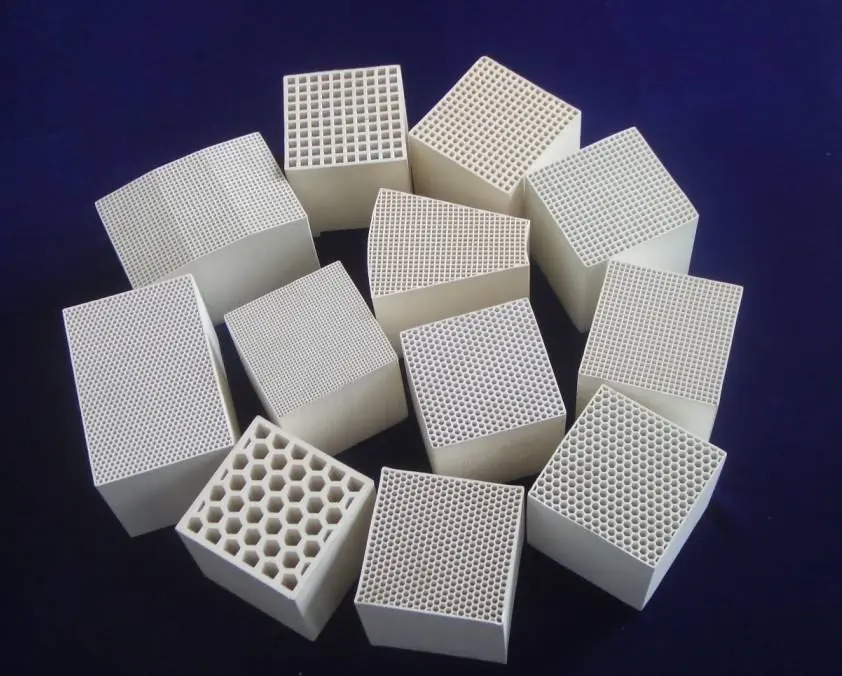

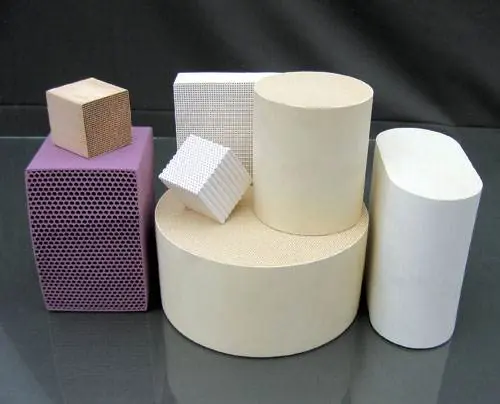
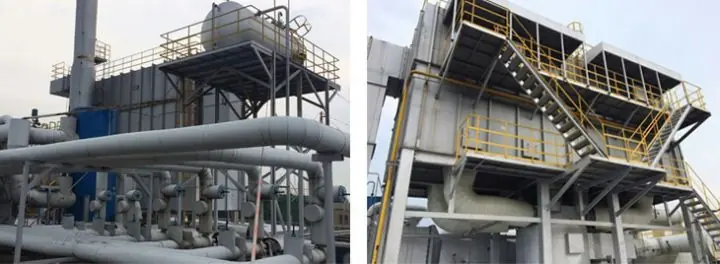
Ceramic Heat Accumulation Substrate
Product Overview
PRUITING® Honeycomb ceramic heat accumulation substrate are made of corundum-mullite, cordierite-mullite, cordierite, mullite, zirconia-mullite, carbo-corundum and so on with different hole shapes, such as square hole and hexagon hole, different wall thicknesses from 0.5mm to 5mm, and different figure specs.
Ceramic Honeycomb as the media of heat storage and heat exchange, has been widely applied in the fields of metallurgy, petroleum & chemical industry, electric power, boiler and so on.
It has high surface area, small resistance and thermal expansion, strong chemical corroding resistance, excellent thermal shock resistance.
Key Benefits
Technical Features and Key Benefits
- Made of corundum-mullite, cordierite-mullite, cordierite, mullite, zirconia-mullite and carbo-corundum
- Square hole and hexagon hole shapes available
- Wall thickness from 0.5mm to 5mm and different figure specifications
- High surface area with small resistance and small thermal expansion
- Strong chemical corroding resistance and excellent thermal shock resistance
Who It Is For
Buyers Who Specify This Product
- Metallurgy plants using regenerative heating
- Petroleum and chemical industry thermal process operators
- Electric power and boiler plant engineering companies
Problems It Solves
What It Fixes in the Exhaust Line
- Heat lost from industrial furnaces and thermal processes
- Media that crack under repeated thermal cycling
- Chemical corrosion of heat exchange media in aggressive flue gas
Specifications
Published Sizes and Technical Data
A). Specification for cordierite heat accumulation substrate:
Chemical analysis
| Composition | Value(%) |
|---|---|
| Al2O3 | 28~38 |
| SiO2 | 45~55 |
| MgO | 12~14 |
| Others | < 5 |
Physical properties
| Index | Unit | Value |
|---|---|---|
| Density | g/cm3 | 1.7~2.0 |
| Coefficient of heat expansion | (X10-6K-1) (20-800°C) | ≤3.0 |
| Specific Heat | (J/Kg.k)(20 - 1000°C) | 900~1150 |
| Thermal Conductivity | (20 - 1000°C) | 1.2 - 1.8 |
| Impact Thermal Resistance | (°C/min) | ≥350 |
| Max.Working Temp. | °C | 1320 |
| Water absorption | % | 15~25 |
Dimension and other physical properties
| Dimension | Quantity of channels | Wall thickness | Outside wall thickness | Channel Width | Void section | Weight piece |
|---|---|---|---|---|---|---|
| 150×150×300 | 25×25 | 1.0mm±0.1 | 1.2mm±0.15 | 4.8-5.0mm | 67% | 3.2-4.2kg |
| 150×150×300 | 32×32 | 0.9mm±0.1 | 1.2mm±0.15 | 3.8-3.9mm | 61.6% | 3.7-4.7kg |
| 150×150×300 | 40×40 | 0.7mm±0.1 | 1.1mm±0.15 | 2.9-3.1mm | 64% | 3.6-4.6kg |
| 150×150×300 | 43×43 | 0.65mm±0.1 | 1.1mm±0.15 | 2.7-2.9mm | 62% | 3.7-4.7kg |
| 150×150×300 | 50×50 | 0.6mm±0.1 | 0.8mm±0.15 | 2.3-2.5mm | 61% | 3.8-4.8kg |
| 150×150×300 | 60×60 | 0.45mm±0.1 | 0.8mm±0.15 | 1.9-2.1mm | 63.4% | 3.6-4.6kg |
Figures above are reproduced from the PRT published specification. Dimensions in mm unless stated otherwise. Ø denotes diameter.
FAQ
Ceramic Heat Accumulation Substrate FAQ
Which materials can the media be made from?
Corundum-mullite, cordierite-mullite, cordierite, mullite, zirconia-mullite, carbo-corundum and so on.
What is the maximum working temperature of the cordierite grade?
The published physical property table gives a maximum working temperature of 1320 °C for the cordierite heat accumulation substrate.
Which hole shapes and wall thicknesses are available?
Square hole and hexagon hole shapes, with wall thicknesses from 0.5mm to 5mm and different figure specifications.
Where is this media used?
Ceramic honeycomb as the media of heat storage and heat exchange has been widely applied in the fields of metallurgy, petroleum and chemical industry, electric power and boiler.

