
- Home
- Knowledge Center
- How to Choose an LED Sign Module by the Depth of the Sign
How to Choose an LED Sign Module by the Depth of the Sign
The published depth band is the one figure that decides whether a face lights evenly. Here is what the band means, why it exists, and the full depth map across all twenty-five products on this site.
What the depth band actually measures
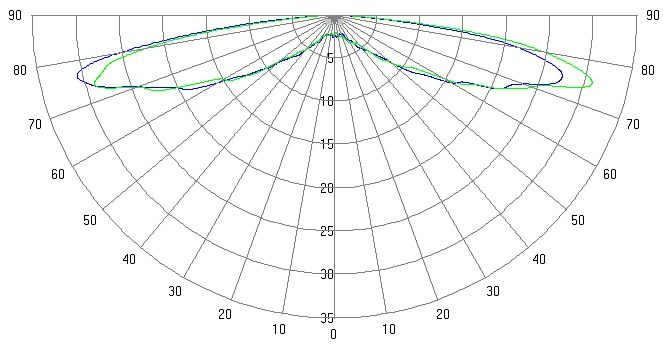
Every module page on this site publishes a sign depth it is designed for: 30 to 50 mm, 80 to 120 mm, 120 to 200 mm and so on. That figure is not the height of the letter or the size of the sign. It is the distance from the face of the module to the inside surface of the acrylic it is lighting. That distance is the only thing that decides whether the cone of light from each module has spread far enough to overlap its neighbour before it reaches the face.
Why too shallow shows dots and too deep goes dim
Put a module rated for 80 to 120 mm into a 35 mm return and the cones never overlap: each module shows through the acrylic as a bright patch with dark acrylic between them. Put a module rated for 30 to 50 mm into a 200 mm cavity and the opposite happens: the light has spread so far by the time it arrives that the face is evenly lit but dim, and the run needs far more modules than it should to hit a usable brightness.
The depth map across this range
From shallowest to deepest, the published bands run: 25 to 50 mm on the 2618B; 30 to 50 mm on the 1208B, 3208B and 1812B; 30 to 60 mm on the 5118B; 40 to 70 mm on the 7618B and 4543B; 50 to 80 mm on the 4116B; more than 60 mm on the 3828B and 3828D; 80 to 120 mm on the 6616B, 6515B, 6515RGB/W and the 6616B/AC; 120 to 200 mm on the 3939B and the 3939B/AC; and more than 150 mm on the 3636RGBW. The side-emitting models publish their bands differently, as 50 to 100 mm for a single-sided box and 60 to 200 mm for a double-sided one.
Beam angle is the second filter, not the first
Once the depth band has cut the list down, the beam angle decides the pitch. Most of this range publishes 175 degrees, the 3828 family publishes 170, the RGBW models 160, and the mini range publishes an asymmetric 120 x 170 degrees. A wider angle spreads sooner, which means the modules can sit further apart at the same depth.
What to do when the depth is between two bands
Both models become candidates and the choice moves to brightness and pitch: how many lumens the face needs and how many modules you are willing to wire into it. What does not happen is going outside a published band because a model is cheaper or in stock. That decision is the origin of most of the complaints this industry has about module quality.
Products Referenced In This Guide
JDS-1208B
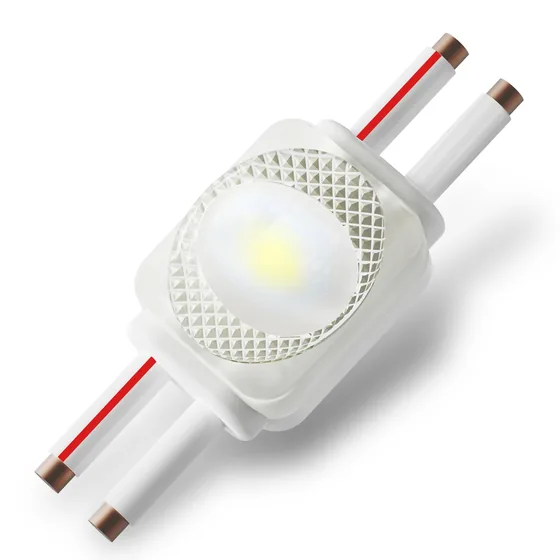
The smallest module published here at 12 x 8 x 8.5 mm, 0.36 W, IP68, for narrow strokes in signs 30 to 50 mm deep.
See the specification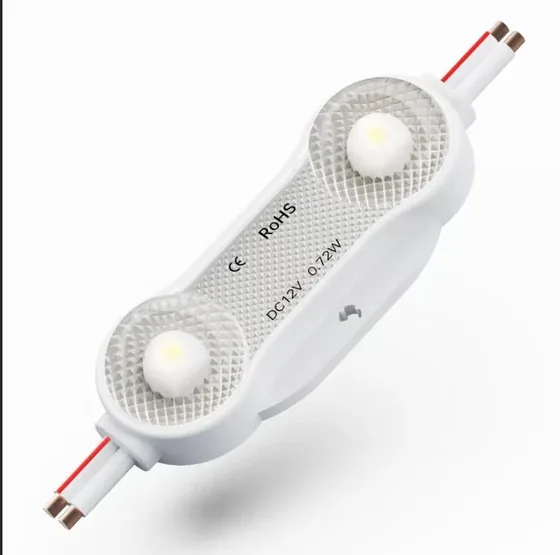
JDS-4116B
Two-lens 41 mm module at 170 lm/W and IP68, for signs 50 to 80 mm deep.
See the specification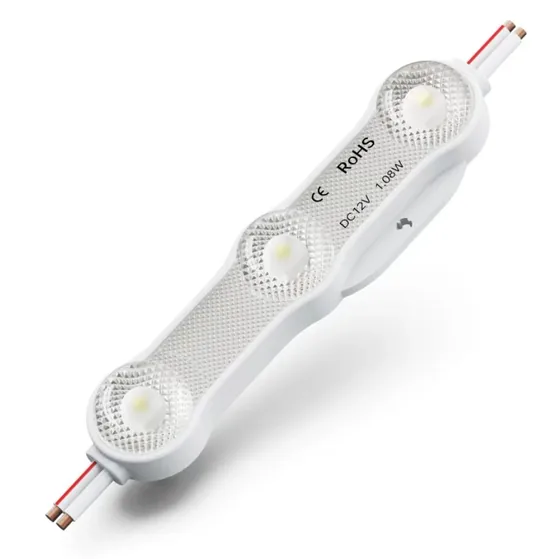
JDS-6616B
Three-lens 66 mm module at 170 lm/W and IP68, for deep channel letters and light boxes 80 to 120 mm deep.
See the specification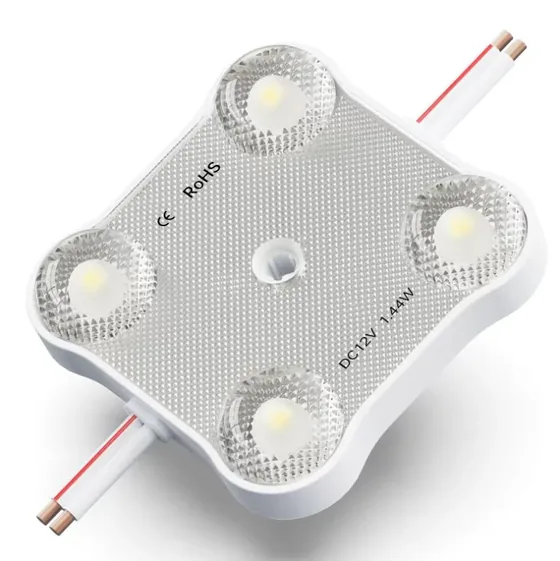
JDS-3939B
Square four-lens DC module, 245 lm per piece, IP68, for deep signs 120 to 200 mm behind the face.
See the specificationProduct Families Covered
Questions About This Guide
Is the depth band measured to the face or to the front of the sign?
Can a diffuser make a shallow sign work with a deep-rated module?
Put This Into Practice
Send the internal depth of the sign you are working on and a recommendation with the matching published specification comes back.