
- Home
- Knowledge Center
- Cascade Limits and Voltage Drop in LED Module Runs
Cascade Limits and Voltage Drop in LED Module Runs
Why every product page publishes a maximum number of modules per feed, what happens past it, and how the single-ended and double-ended figures differ.
What the cascade figure is
Every module page here publishes a line like '20 modules single-ended power feed, 50 modules double-ended power feed'. It is the maximum number of modules that may be chained from one power injection point before the voltage arriving at the last module has dropped far enough to be visible.
Why single-ended and double-ended differ
Feeding from one end means all the current for the whole chain passes through the first module's lead wires. Feeding from both ends halves the current in each half of the chain, which is why the published figure roughly doubles - 20 becomes 50 on the full-size range and 50 becomes 100 on the mini range.
What running past the limit actually looks like
It rarely fails outright. It dims: the last few characters of a long fascia sit visibly darker than the first few, and the difference gets worse as the modules age. Because it is gradual, it is usually blamed on a bad batch rather than on the wiring, which is why it keeps happening.
The figures across this range
Most full-size modules publish 20 single-ended and 50 double-ended. The mini range - 1208B, 3208B and 1812B - publishes 50 and 100, because each module draws less. The 6515RGB/W and 6615RGBW publish 50 modules per chain. The 3636RGBW page adds the reason explicitly: because of voltage drop, a maximum of 50 modules can be run before power needs to be reintroduced.
Designing the feed points before the wiring
Divide the module count in the run by the published cascade figure and round up. That is the number of injection points, and it belongs on the drawing before anyone starts wiring. Adding them afterwards means opening a sign that has already been sealed.
Products Referenced In This Guide
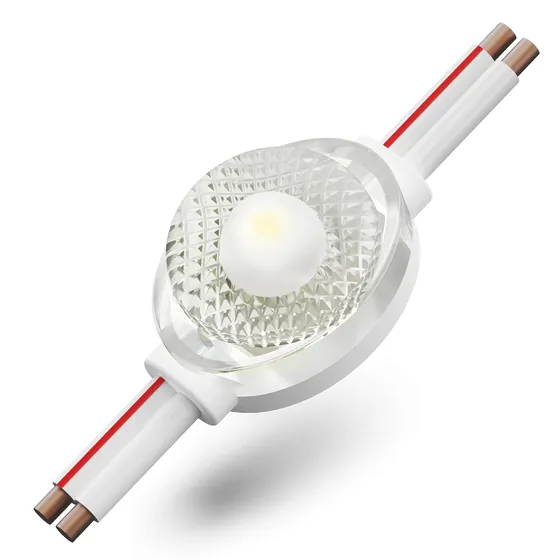
JDS-1812B
Single-lens mini module, 18 x 12 x 9 mm at 170 lm/W and IP68, 100 modules per double-ended run.
See the specification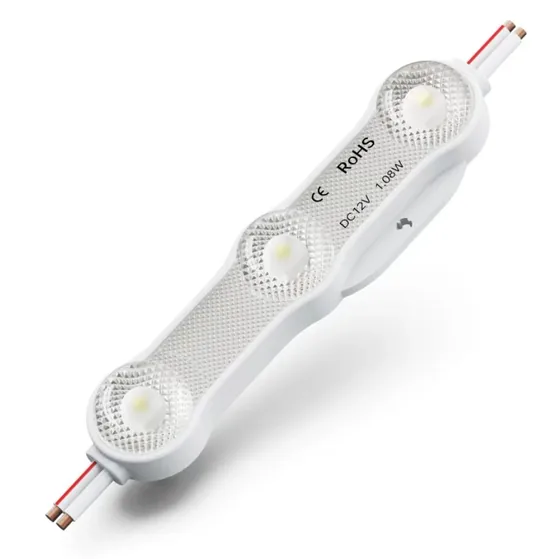
JDS-6616B
Three-lens 66 mm module at 170 lm/W and IP68, for deep channel letters and light boxes 80 to 120 mm deep.
See the specification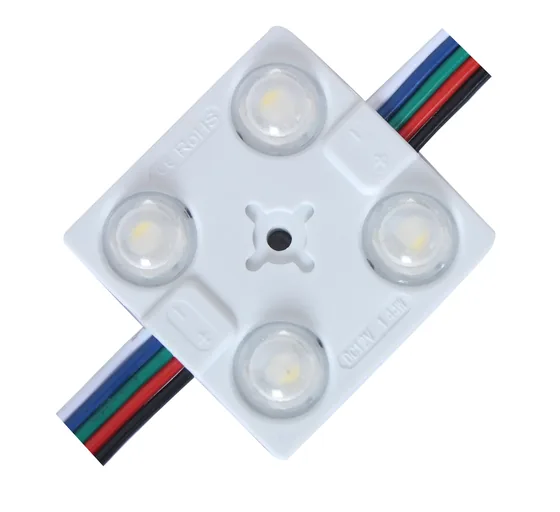
JDS-3636RGB/RGBW
1.44 W RGB/RGBW module at 100 lm/W, IP67, nine pieces per metre, for signs deeper than 150 mm.
See the specificationProduct Families Covered
Questions About This Guide
Does a thicker lead wire raise the cascade limit?
Do the strips have a cascade limit too?
Put This Into Practice
Send the internal depth of the sign you are working on and a recommendation with the matching published specification comes back.