
Cubic Zirconia and Moissanite Stone Setting
A tennis bracelet is really a stone setting problem wearing a bracelet. Whether the stones sit level, and whether they stay in, is what separates the piece that comes back from the piece that does not.
Set by hand, stone by stone
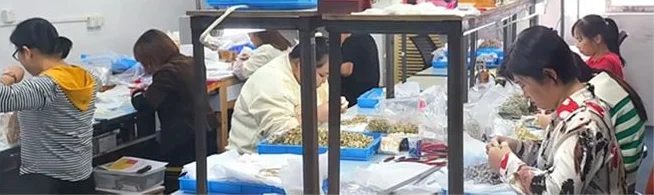
Stones are set at the bench rather than dropped in by machine. On a full tennis line that is a large number of individual settings on a single piece, and it is the slowest step in the process for a reason.
Cubic zirconia
The workhorse stone across the catalogue. Cut and graded for consistency so a row of stones reads as one continuous line rather than as separate stones of slightly different tone.
Moissanite
Harder than cubic zirconia and noticeably brighter. Used across the tennis bracelets and full-diamond styles where the buyer is paying for the sparkle.
Opal and natural stone
Opal runs through a large part of the catalogue. Because the colour play is internal to the stone, every piece varies slightly - that is the nature of the material rather than a defect.
How It Runs
- Stone selectionCut, size and colour agreed before setting.
- Seat preparationEach seat is cut so the stone sits level.
- SettingProng, channel, bezel or micro pave depending on the design.
- Tightness checkEvery stone is checked at the bench.
- PolishingFinal polish without dulling the stones.
- InspectionStone security is one of the 6 inspection rounds.
Sixteen Steps in the Workshop
Whichever route your order takes, it passes through the same documented process.
Concept and Design
CAD drawing and 3D rendering from your sketch, sample or reference photo.
Plate Making
The master pattern is cut and finished by hand before any mould is made.
Manufacture of Moulds
Silicone moulds are cut from the master so the shape repeats exactly.
Mould Injection Wax
Wax is injected into the mould to produce the pattern for each piece.
Wax Inlay
Stones that are cast in place are set into the wax at this stage.
Growing Wax Trees
Wax patterns are assembled onto a sprue tree ready for investment.
High Temperature Furnace Melting
Brass, silver or steel is melted and poured into the invested flask.
Cutting Table
Cast pieces are cut from the tree and the sprue marks are removed.
Sanding
Each piece is sanded to take out casting texture before finishing.
Buckle and Chain
Clasps, jump rings and chain sections are fitted to the body.
Welding
Joints and findings are welded so the piece holds under daily wear.
Grinding
Barrel and wheel grinding evens the surface across the whole batch.
Stone Setting
Cubic zirconia, moissanite and opal are set by hand, stone by stone.
Polishing
Hand polishing brings the metal up before it goes to the plating line.
Plating
Yellow gold, white gold or rose gold is plated over the finished body.
Assembly
Final assembly, inspection and packing for the order.
Other Solutions
OEM and ODM Manufacturing
Bring us a drawing and we will build it, or start from our design team and sell the result under your own brand. Both routes run through the same 16 s
Private Label and Packaging
The piece is half of what your customer receives. The box, the card and the pouch are the other half, and they are where a private label range starts
Sampling and Prototyping
The cheapest place to find a problem is on one piece rather than on five hundred. Sampling is not a formality in this process - it is the step that pr
Ready to Ship Stock
Most of the range is held in stock. That is the difference between restocking a listing this week and restocking it next month.
Plating and Finishing
Plating is where cheap jewelry gives itself away first - at the clasp, at the shoulders of a ring, wherever the piece rubs. It is worth specifying rat
Stone Setting - Questions
How does stone setting start?
Email describing what you need. Michael Xiao will come back with the questions that have to be answered before a quotation can be accurate.
Is there a charge for sampling?
Sampling and tooling are quoted per development. The cost depends on how much new tooling the design needs - a change to an existing style costs far less than a new mould.
Do you keep our moulds?
Yes. The mould stays on your account, which is why a repeat order is quicker and cheaper than the first one.
Can you work from a physical sample?
Yes - a physical sample is the easiest reference to work from. A photograph, a sketch or a CAD file all work too.
What happens if the sample is not right?
It gets corrected and re-sampled. That is the entire purpose of the sampling stage, and it is far cheaper than correcting a bulk order.
Start a Stone Setting Enquiry
The more of the specification you can fix up front, the more accurate the quotation will be.