
Ask five Chinese suppliers for a price and you may receive five different bases: EXW, FOB, CIF, DDP, or simply “price”. Before comparing numbers you need to know what each includes. This guide focuses on the FOB price — the most common quotation basis for sea freight from China — and shows how to turn it into a landed cost.
What is an FOB price?
FOB (Free On Board) is an Incoterms® rule published by the International Chamber of Commerce. Under the current 2020 version, the seller delivers the goods on board the vessel nominated by the buyer at the named port of shipment, cleared for export. Risk passes to the buyer once the goods are on board.
So what is FOB price in practical terms? It is the unit price including:
- the goods themselves and standard export packing;
- transport from the factory to the named Chinese port;
- Chinese export customs clearance;
- origin port handling up to loading on board.
It excludes ocean freight, insurance, destination charges, import duties and taxes, and delivery to your door. Note that FOB is intended for sea and inland waterway transport; for containers handed over at a terminal or for air freight, FCA is technically the better fit, although FOB remains widely used in China quotations.
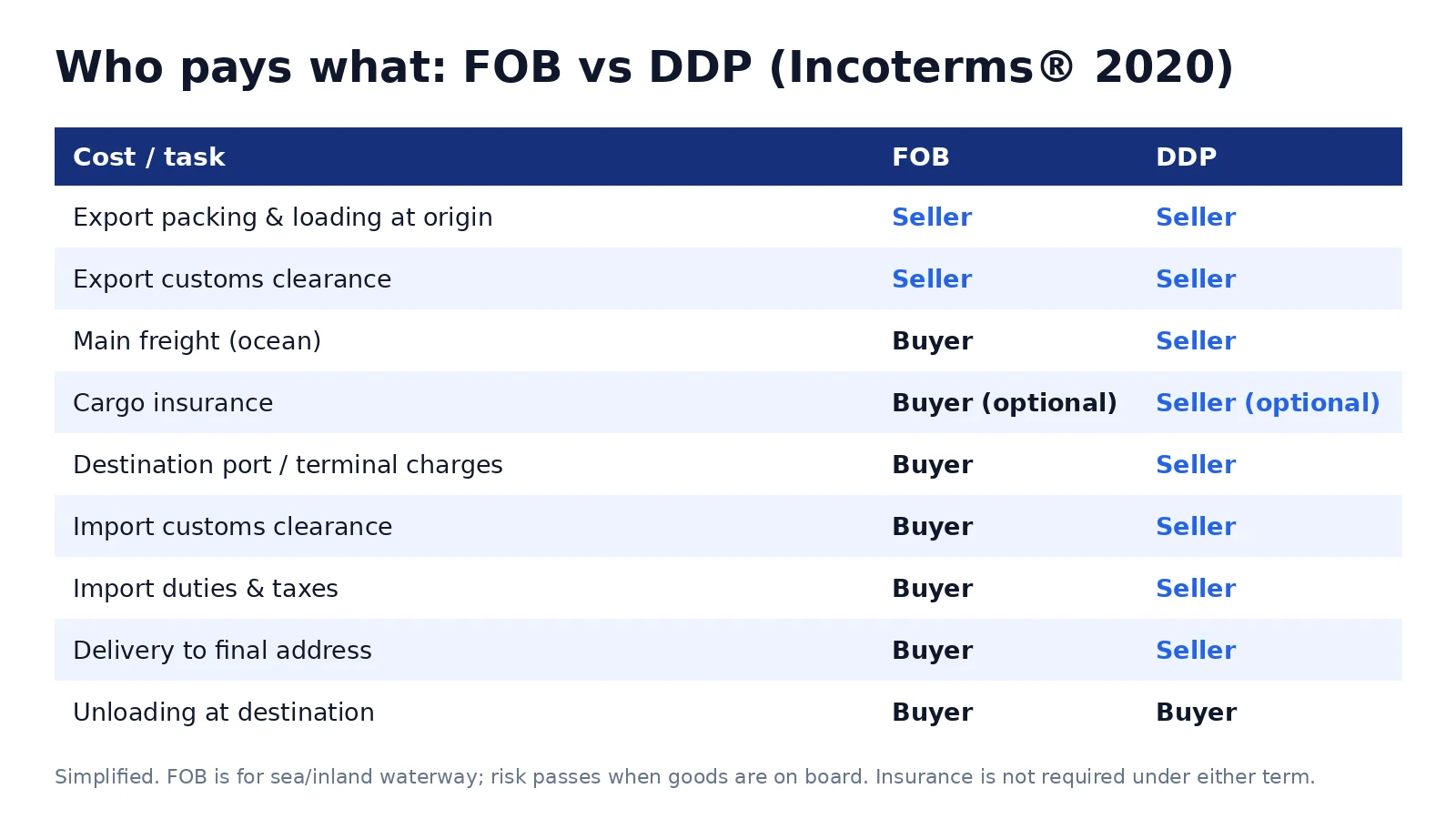
DDP: what the seller takes on
The DDP Incoterms meaning: Delivered Duty Paid. The seller bears all costs and risks to deliver the goods to the named destination, including import clearance and duties; the buyer only unloads. It looks like the simplest option, and for small shipments it can be. The trade-offs:
- The seller (or its agent) must act as importer, so you have less control over how goods are classified and valued at customs.
- Freight and duty margins are built into one price, which makes it harder to see what you are paying for.
- If duties change after the quote, disputes can follow unless the contract addresses it.
CIF vs FOB, and FCA vs EXW
CIF vs FOB: under CIF (Cost, Insurance and Freight) the seller also pays ocean freight and minimum insurance to the destination port, but risk still passes when goods are loaded in China. CIF looks convenient, yet the buyer then pays destination charges set by the seller’s chosen forwarder — which can be higher than expected. Many importers prefer FOB so they control the freight contract.
FCA vs EXW: under EXW the buyer collects at the factory and is responsible even for export clearance — awkward for foreign buyers in China. FCA (Free Carrier) has the seller hand goods, export-cleared, to the buyer’s carrier at an agreed place. That is why the Incoterms FCA vs EXW comparison usually favours FCA for buyers who would otherwise choose EXW.
Building a landed-cost sheet
Landed cost is the total cost per unit to get goods into your warehouse. Build it line by line rather than estimating a percentage:
| Line | Source of the number |
|---|---|
| FOB unit price × quantity | Supplier quotation |
| Tooling, moulds, sample fees (amortised) | Supplier quotation |
| Inspection fee | Inspection company quote |
| Ocean or air freight | Forwarder quote for your route and volume |
| Cargo insurance (optional) | Forwarder or insurer |
| Destination port and handling charges | Forwarder quote |
| Customs broker fee and bond | Broker quote |
| Import duties and fees | Broker, based on HTS classification and current rates |
| Delivery to warehouse | Forwarder or trucker quote |
Divide the total by the number of sellable units. For US imports, duty rates on Chinese goods have changed several times in recent years, so ask your broker for the current rate on your HTS code rather than reusing an old figure.
How MOQ changes the math
MOQ in business purchasing means minimum order quantity: the smallest order a supplier accepts. It affects landed cost in two ways. First, fixed costs — tooling, sample fees, inspection, broker fees, part of the freight — are spread over fewer units on a small order. Second, a shared LCL shipment usually costs more per cubic metre than a full container. When you compare a supplier offering a low MOQ against one with a higher MOQ and lower unit price, compare total landed cost per unit at each realistic quantity, not unit price alone.
Where AQL inspection fits
An AQL inspection is a sampling-based quality check using standards such as ISO 2859-1: an inspector examines a sample sized by lot quantity and inspection level, and the lot passes or fails against the acceptance limits you set for critical, major and minor defects. It belongs on the landed-cost sheet for two reasons: it has a direct fee, and it protects the rest of the sheet. A defective container that reaches your warehouse carries its full freight and duty cost with it.
Write into the contract who pays for re-inspection if a lot fails, and make the balance payment conditional on a pass. Labels are part of inspection too — confirm origin markings meet destination rules (see why “Made in PRC” alone fails US marking rules).
Common landed-cost mistakes
- Comparing mixed Incoterms. An EXW price will always look cheaper than FOB from another supplier; convert every quote to the same basis first.
- Using volume instead of chargeable weight. Air freight is billed on the greater of actual and volumetric weight, which surprises buyers of light, bulky goods.
- Forgetting destination charges. Terminal handling, documentation and delivery charges at the US end can be significant, especially for LCL.
- Ignoring payment costs. Bank transfer fees and currency conversion are small per order but add up.
- Using an old duty rate. Re-check the rate before every significant order.
Quick reference: which term should you ask for?
- FOB named port — default for sea freight when you have a forwarder.
- FCA — better technical fit for containers handed over at a terminal, and for air freight.
- DDP — small, simple shipments where convenience outweighs control.
- EXW — only if your forwarder has a strong China operation.
Timing matters as much as cost: see how long shipping from China takes. For supplier-side terms such as OEM vs ODM and tooling ownership, weisourcing’s supplier terms checklist is a good companion. Browse category-specific buyer’s guides for examples of how pricing tiers differ by product.
Want quotes you can actually compare?
Send your specification and destination. We will point you to directory suppliers for your category and tell you what to add to the RFQ so every quote comes back on the same basis.