Tired of plugging in cables, especially fumbling for the port in the dark? Wireless charging pads look sleek and simple, but how exactly do they beam power to your phone without any physical...
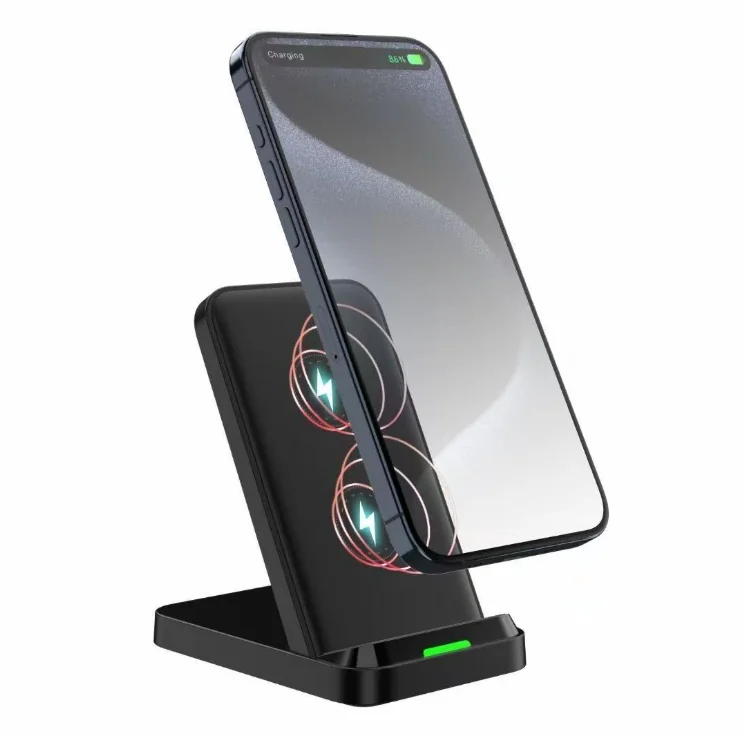
Tired of plugging in cables, especially fumbling for the port in the dark? Wireless charging pads look sleek and simple, but how exactly do they beam power to your phone without any physical connection?
Wireless charging primarily uses electromagnetic induction. A transmitter coil inside the charging pad creates a changing magnetic field when powered, and a receiver coil inside your compatible device converts this magnetic field back into electrical current to charge the battery.
It sounds a bit like science fiction, doesn’t it? But it’s based on real physics principles that have been understood for over a century. As someone who works with charging technology every day at FUMEI, including exploring wireless options, I find it fascinating how we package this old science into convenient modern gadgets. Let’s look closer at the process.
Seeing your phone light up just by placing it down feels futuristic, almost magical. It’s easy to wonder if it’s using complex radio signals or something even stranger to send power through the air.
It’s not magic, and while it involves electromagnetic fields, it’s different from radio waves used for Wi-Fi or Bluetooth. It uses near-field inductive coupling – creating a short-range, non-radiative magnetic field between two specially matched coils.
The key is understanding a basic principle called Faraday’s Law of Induction. In simple terms, a changing magnetic field can create an electric current in a nearby wire coil. Wireless chargers exploit this directly.
Think of it like a transformer where the two halves (the coils) are physically separated by a small gap instead of being wound around the same core. This energy transfer is efficient only over very short distances (millimeters), which is why you need to place the device directly on the pad.
| Process Step | What Happens | Location |
|---|---|---|
| 1. Power Input | Pad receives power, converts it to high-freq AC | Charging Pad |
| 2. Field Generation | Transmitter coil creates changing magnetic field | Charging Pad |
| 3. Field Coupling | Magnetic field links pad coil to device coil | Air Gap |
| 4. Current Induction | Receiver coil gets AC current from the field | Device |
| 5. Power Conversion | Device converts induced AC to DC | Device |
| 6. Battery Charging | DC power charges the battery | Device Battery |
Knowing it uses coils and magnetic fields is one thing. But what are the actual physical components inside that sleek pad and your thin phone that handle this invisible energy transfer?
The two essential sets of components are the charging pad (transmitter) containing electronics and a transmitter coil, and the compatible device (receiver) housing a receiver coil along with power conversion and charging management circuits.
These parts need to work together seamlessly and safely. Let’s identify the main players on each side.
Alignment between the transmitter and receiver coils is crucial for good power transfer efficiency. This is why you usually need to place the device in a specific spot on the pad.
| Location | Component | Primary Function |
|---|---|---|
| Charging Pad | Control Circuitry | Manages power, creates high-frequency AC, communicates (Qi) |
| Charging Pad | Transmitter Coil | Generates the changing magnetic field |
| Device | Receiver Coil | Captures magnetic field, induces AC current |
| Device | Rectifier Circuit | Converts induced AC to DC |
| Device | Charging Circuit | Manages battery charging, ensures safety, communicates (Qi) |
Okay, the tech involves matched coils. But seeing different brand names and logos raises a question: Do I need a specific brand of charger for my specific phone, or will any pad work?
Yes, standards are very important here. The most widely adopted global standard for wireless charging is Qi (pronounced "chee"). Using Qi-certified chargers and devices ensures they will work together safely and efficiently.
Imagine the early days of phone chargers before USB became common – every phone needed its own specific plug! Standards like Qi prevent that chaos in the wireless world.
| Feature | Qi Standard (WPC) | Proprietary / Non-Standard |
|---|---|---|
| Compatibility | Broad (cross-brand, if Qi certified) | Limited (often brand-specific) |
| Safety Checks | Standardized (FOD, temp monitoring) | Variable, may lack features |
| Typical Speed | 5W (BPP), up to 15W+ (EPP) | Can vary, sometimes faster (if matched) |
| Market Share | Dominant | Niche / Declining for basic charging |
So, when buying a wireless charger or checking if your phone supports it, looking for the Qi logo is the easiest way to ensure compatibility and safety.
Wireless charging works using electromagnetic induction between coils in a pad and your device. Governed mainly by the Qi standard, it offers a convenient, cable-free way to power up your gadgets by simply placing them down.
We manufacture what these articles describe, in China and in Vietnam.
FUMEI builds power adapters, wall chargers, car chargers and wireless chargers in China and Vietnam.