
- Startseite
- Wissenszentrum
- Wie ein benutzerdefiniertes Stück von einer Skizze zu einem Casting geht
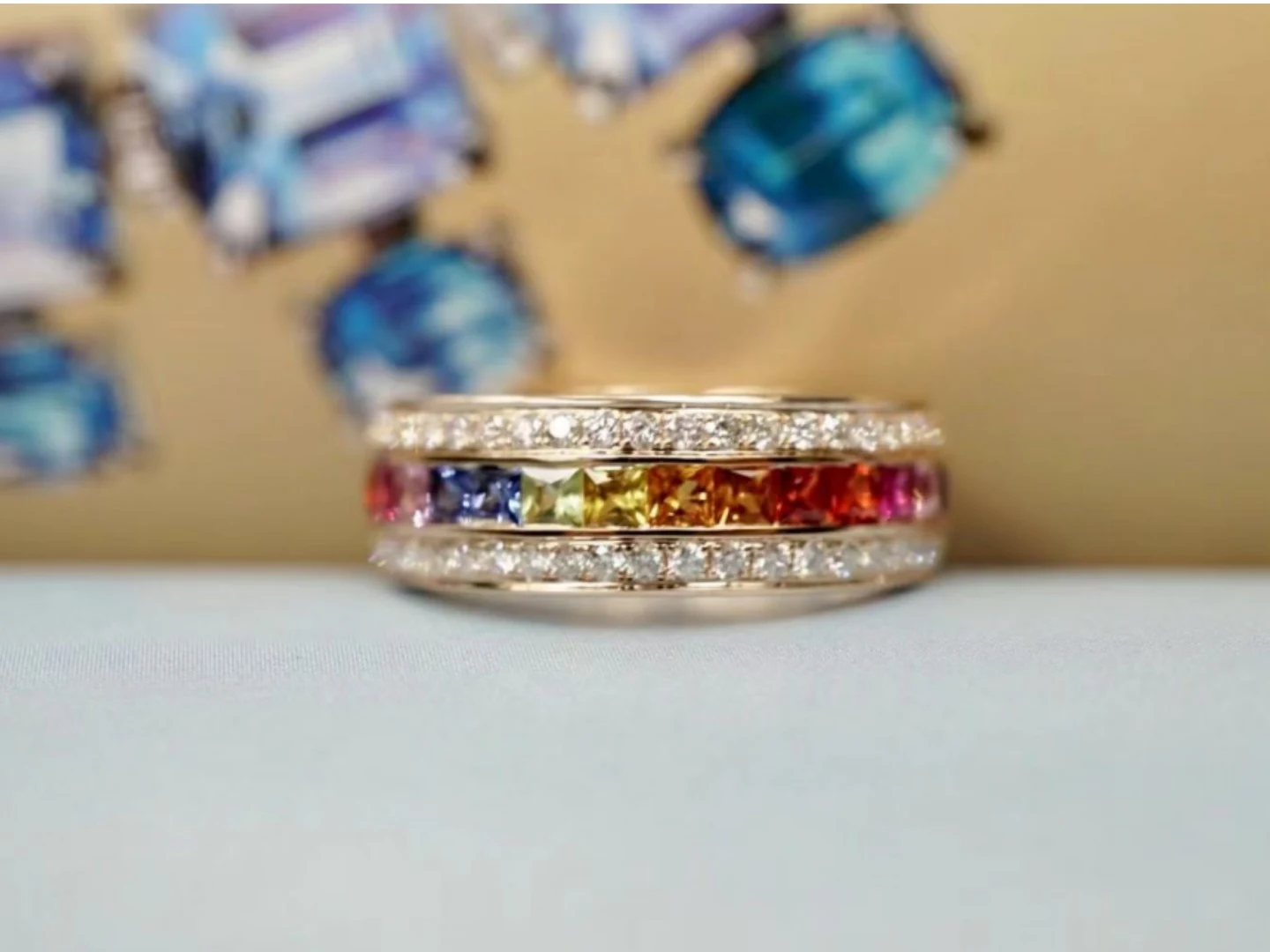
Wie ein benutzerdefiniertes Stück von einer Skizze zu einem Casting geht
Acht Stufen, jede billiger zu ändern als die nächste. Fast jeder teure Fehler bei benutzerdefiniertem Schmuck ist eine zu schnelle Genehmigung in Stufe zwei oder drei.
Sketch: The Cheapest Place To Be Wrong
The factory states its design team works from basic napkin sketches upward. A drawing costs an email to change. Use this stage to settle proportions and stone sizes, not to admire a rendering.
CAD: Where The Cost Is Decided
The 3D model fixes stone seats, wall thickness and gallery openings. That is where metal weight, and therefore most of the price, is set. A model also makes the piece reproducible by a computer-controlled process later, which is the difference between a repeat order and a rebuild.
Wax: The Last Cheap Change
Molten wax is injected into the mould cavity under pressure. A wax can be held, slipped onto a finger and rejected for the cost of an afternoon. If a shank feels thin or a shoulder feels wide, this is the moment it is discovered, and almost nobody asks for a wax as often as they should.
Casting And Filing: Where Metal Stops Being Reversible
The wax is invested and burned out, and the piece is cast in the specified karat. Filing then removes surplus metal and smooths the surface. From here on, a change means starting again from the model.
Setting And Polishing: The Part That Cannot Be Automated
Prong, bezel, channel and pave work is done by hand at the bench. On multi-stone pieces the sequence is laid out and approved before the first stone goes in, because unsetting a row is far more expensive than rearranging one.
What To Ask For At Each Stage
A dimensioned drawing at stage one. A render plus the estimated finished metal weight at stage two. A photograph of the wax on a sizer at stage three. A photograph of the stone layout before setting on anything with a row or a colour sequence.
Produkte, auf die in diesem Leitfaden verwiesen wird
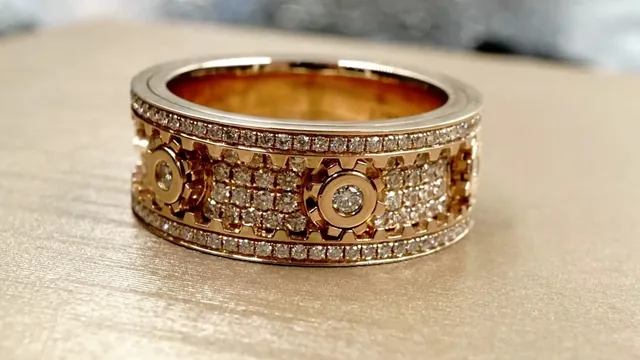
Handgefertigter geometrischer 3D Spinner Diamond Band Ring
Ein breites verziertes 3D-Band mit einem Arbeitsritzel: der äußere Rand dreht sich frei gegen den Kern, mit Diamantakzenten über die geometrische Fläche.
Siehe Spezifikation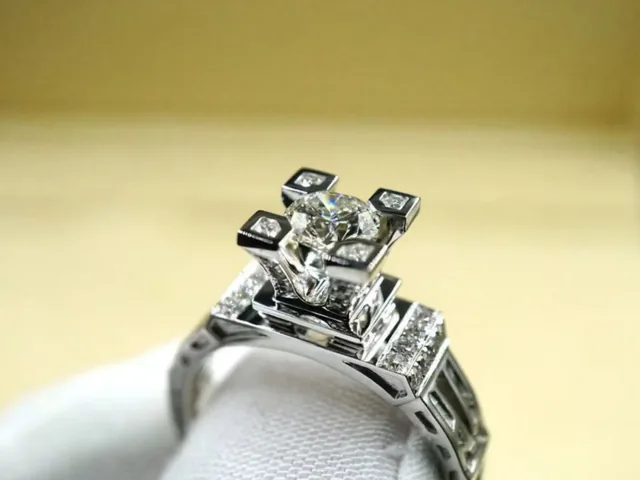
Eiffelturm 1. Diamant-Verlobungsring
Ein skulpturaler Verlobungsring, dessen Schultern die Silhouette des Eiffelturms bilden und einen natürlichen Diamanten der Farbe 1 ct 6,5 mm VVS F auf einem 18K Weißgoldband tragen.
Siehe Spezifikation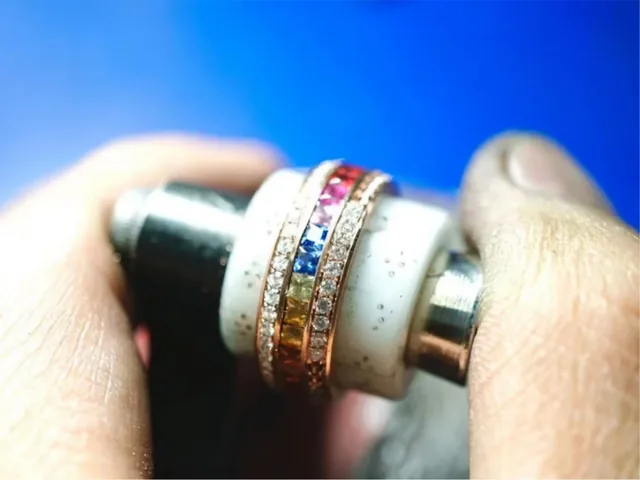
Rainbow Sapphire und Diamond Eternity Ring
Ein breites 18K Roségold-Band-Kanal-Set mit 30 quadratischen Regenbogen-Farbsaphiren bei etwa 1,85 ct, umgeben von 66 runden Diamanten bei etwa 0,55 ct.
Siehe SpezifikationErfasste Produktfamilien
Fragen zu diesem Guide
Can I skip the wax to save time?
How long does the whole process take?
Setzen Sie dies in die Praxis um
Senden sie, was sie wollen, und eine empfehlung kommt zurück mit den übereinstimmenden spezifikationen kommt zurück per e-mail.